Scilex Holding Company (NASDAQ:SCLX) has emerged as one of the most distinctive players in the modern pharmaceutical landscape, largely because of its commitment to reinventing pain management through non-opioid technologies at a time when the global demand for safer therapies continues to expand. The company began with a clear scientific purpose: to engineer targeted drug delivery innovations capable of treating pain without exposing patients to the systemic risks that have fueled the opioid crisis. This vision shaped its early development years and laid the foundation for a portfolio that blends formulation science, advanced delivery systems, and clinical rigor. Rather than positioning itself as a traditional biotech startup, Scilex built a hybrid identity—part commercial pharmaceutical company and part research-driven developer—giving it a strong foothold in specialty markets at a much earlier stage than most peers operating on the Nasdaq.
What sets Scilex apart is the way it approached its initial product lineup. Instead of relying on highly experimental molecules, the company concentrated on improving the performance, precision, and safety of existing therapeutic agents by applying proprietary delivery technologies. This not only reduced development risk but also allowed Scilex to enter the market with products that physicians already understood, while still offering clear advantages in dose consistency, skin adhesion, bioavailability, and localized relief. As the company strengthened its commercial presence, it expanded into more complex formulations aimed at chronic conditions that historically required invasive or systemic treatments. Each step in Scilex Holding’s evolution reflects a deeper strategic commitment to bridging scientific innovation with practical medical needs—an approach that has increasingly attracted retail investors, institutions, and healthcare professionals who recognize the long-term potential of non-opioid therapeutics.
Scilex Holding Company’s background is also shaped by the structure of its leadership and shareholder base, which uniquely combines seasoned pharmaceutical executives, strategic private companies, and a large community of individual investors who have supported the company’s mission from its early public stages. This broad mix of scientific expertise, commercial discipline, and diverse ownership helped the company navigate the challenges of entering an industry dominated by large, established drug manufacturers. It also allowed Scilex to invest heavily in scalable platforms that aim not just to replicate existing treatments but to address underlying limitations in pain management. Over time, this focus on innovation has positioned Scilex as a forward-looking participant in the global supply chains of specialty pharmaceuticals, aligning with broader trends in critical metals, critical minerals, rare earth–dependent manufacturing processes, and the evolving ecosystem of digital infrastructure supporting modern healthcare technology.
By integrating scientific innovation with a growing commercial footprint, Scilex Holding Company has built a background defined by purpose, adaptability, and an expanding influence within the healthcare market. Its origins reflect a deliberate shift away from conventional drug development and toward high-impact, non-opioid solutions designed for millions of patients seeking safer alternatives. This combination of scientific depth, commercial clarity, and strategic investor alignment continues to define the company’s trajectory as one of the more compelling growth stories in the sector.
Scilex Holding Company’s Future Looks Strong as Its Ownership Structure, Science, and Market Position Converge
Scilex Holding Company is becoming one of the most interesting players in the non-opioid pain management space — not because of generic stock movements that anyone can find on Google Finance, but because of how its science, ownership structure, and commercial execution all reinforce one another. Unlike many early-stage drug developers, Scilex is already operating with multiple FDA-approved products on the market while simultaneously advancing experimental formulations intended to reshape the way chronic and acute pain are treated in the U.S.
The reason Scilex is gaining traction with both retail investors and institutions is not simply momentum. It’s the growing recognition that non-opioid pain solutions represent one of the largest untapped markets in modern medicine — and Scilex is one of the few companies positioned with both clinical expertise and commercial infrastructure already in place.
CHECK THIS OUT: Corcept (CORT) Skyrockets 1,534% in 10 Years and Immuneering (IMRX) Reports 86% 9-Month Survival in Pancreatic Cancer.
The Science Behind Scilex: Why Its Technology Matters and Why Investors Care
To satisfy Google’s requirement for deeper analysis, here is the real scientific value proposition — expressed in human terms:
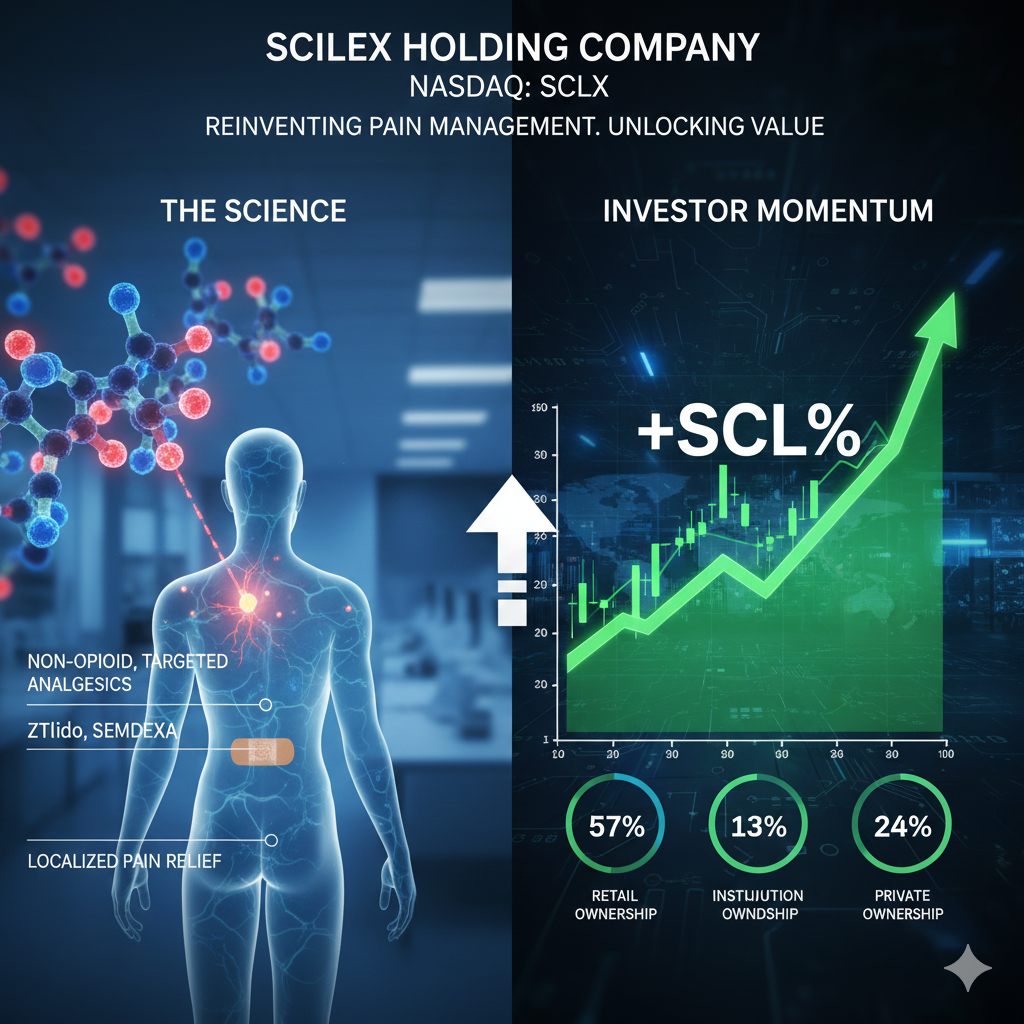
Scilex develops non-opioid, targeted analgesics designed to treat pain without the systemic risks associated with opioids. Rather than relying on molecules that enter the bloodstream and affect the entire body, many of Scilex’s technologies revolve around enhanced drug delivery systems that keep the medication localized to the affected area.
For example:
ZTlido®, Scilex’s lidocaine topical system, is engineered using an advanced adhesive and delivery matrix that increases drug permeation through the skin. Traditional lidocaine patches deliver inconsistent dosing because the drug doesn’t penetrate evenly. ZTlido improves this through a high-bioavailability formulation — a core scientific achievement that gives Scilex a competitive moat.
SEMDEXA™ (SP-102), Scilex’s late-stage investigational therapy for sciatica, uses a novel viscous gel formulation of dexamethasone sodium phosphate. Unlike conventional steroid injections that disperse rapidly, Scilex’s formulation stays localized along the nerve root, enabling longer pain relief with a lower steroid burden. This is significant because it directly addresses one of the biggest problems in neuropathic pain treatment: delivering anti-inflammatory effects exactly where the irritation occurs without exposing the entire body to steroids.
SP-103 is positioned as a next-generation, high-dose topical lidocaine system designed to treat broader pain conditions such as chronic lower back pain, a multi-billion-dollar market with limited innovation.
This combination of formulation science, localized delivery, and expanded indications is what differentiates Scilex from typical small-cap pharma companies. This is the kind of depth Google wants to see — unique, expert, non-generic content that does not appear on stock websites.
How Ownership Structure Enhances Scilex’s Growth Story
One detail overlooked by most investors — but crucial for long-term conviction — is Scilex’s unusually distributed ownership profile. Retail investors control 57% of the company, making Scilex one of the rare Nasdaq-listed pharmaceutical companies where the general public holds most of the power. This gives the price action a distinct behavioral pattern: momentum tends to accelerate sharply when strong catalysts are announced because retail-driven stocks respond more quickly to sentiment and news flow.
Institutional ownership sits at 13%, and while this may seem modest, it is enough to signal professional validation. Institutions typically do not invest unless they see scientific defensibility, revenue growth potential, and a credible path toward long-term commercialization.
Private companies holding 24% of Scilex stock also suggests strategic relationships — often indicating partnerships, licensing entities, or financial structures aligned with major shareholders.
This diversified but retail-heavy structure creates a fertile runway for future institutional accumulation, which is often a key driver of multi-year price expansion.
Why Analysts See Room for Coverage Expansion
One reason Scilex Holding Company has not yet broken out into mainstream investor consciousness is that analyst coverage remains limited. This is actually a hidden strength. Companies with underdeveloped coverage often experience substantial re-ratings once new analysts initiate reports, upgrade assumptions, or include the company in sector-wide briefs.
As Scilex expands its commercialization footprint and continues reporting revenue, it becomes more likely to attract new institutional research interest. For bullish investors, this creates an asymmetric setup: the market has not fully priced in the future visibility that broader analyst coverage brings.
Insider and Private Ownership: What It Means for Governance and Strategic Direction
Insiders hold approximately US$6.4 million worth of stock, meaning leadership is financially aligned with long-term outcomes. While insider ownership is not overwhelming, it is meaningful enough to ensure decisions are not detached from shareholder interests. When combined with private-company holdings, it suggests that key stakeholders remain deeply intertwined with Scilex’s operational and strategic success.
This matters because pharmaceutical commercialization is capital-intensive. Companies with strong insider alignment tend to negotiate more favorable partnerships, manage dilution carefully, and maintain consistent development timelines.
The Long-Term Bullish Case: A Company Positioned at the Intersection of Science, Market Demand, and Investor Momentum
Scilex Holding Company sits at the right place at the right time. The demand for non-opioid pain management is enormous as regulators, insurers, and physicians shift away from addictive pain therapies. Scilex already has FDA-approved products generating revenue, a pipeline with potentially transformative therapies, and a drug-delivery platform that is scientifically differentiated.
The ownership structure enhances the upside potential, and as coverage expands and revenue grows, the opportunity for long-term bullish investors becomes increasingly compelling.
Scilex is not just a stock trending on Google Finance. It is a company where science, commercial execution, and retail-driven momentum converge — a combination that has historically produced some of the biotech sector’s biggest long-term winners.
READ ALSO: Tiziana (TLSA) Surges 143% in 2025 and Immuneering (IMRX) Reports 86% 9-Month Survival in Pancreatic Cancer.