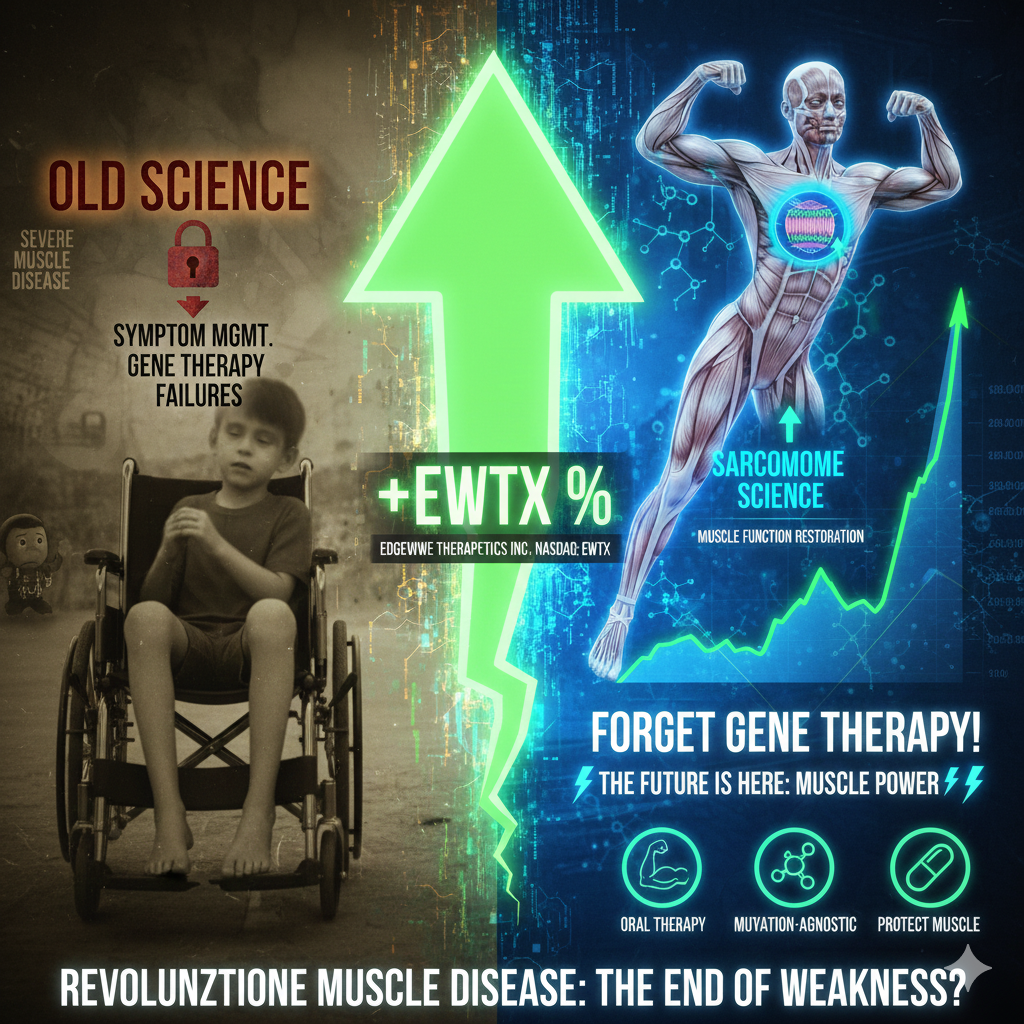
At a time when treatments for severe muscle diseases were largely limited to symptom management and mutation-specific approaches, a biotechnology company began building its foundation around a different scientific premise: that improving how muscle fibers function at the most basic mechanical level could benefit patients regardless of the underlying genetic defect. This idea emerged from advances in muscle biology showing that dysfunction within the sarcomere, the fundamental contractile unit of muscle, plays a central role in progressive muscle weakness across multiple neuromuscular disorders. Rather than attempting to replace missing genes or edit DNA directly, the company’s early work focused on restoring balance to muscle contraction itself.
Edgewise Therapeutics Inc. (NASDAQ:EWTX) was founded to translate this biological insight into precision small-molecule medicines for serious muscle diseases with high unmet need. Headquartered in the United States, the company positioned itself at the intersection of deep muscle physiology research and scalable drug development, favoring orally administered therapies that could be dosed chronically and adjusted over time. From the outset, Edgewise Therapeutics concentrated on conditions such as Duchenne and Becker muscular dystrophy, where muscle damage accumulates over years and existing therapies often fail to preserve long-term function.
The scientific foundation of Edgewise Therapeutics centers on the sarcomere, a microscopic structure composed of actin and myosin proteins that generate force when muscles contract. In healthy muscle, this system is tightly regulated, but in dystrophinopathies and related disorders, repeated contractions cause excessive mechanical stress and progressive fiber damage. Edgewise’s drug candidates are designed to selectively modulate fast skeletal muscle myosin, reducing harmful force during contraction while maintaining the ability to generate strength. This approach aims to protect muscle tissue over time rather than produce short-lived functional gains.
Edgewise Therapeutics advanced this concept through extensive preclinical research and early human studies, establishing proof that myosin modulation could lower biomarkers of muscle injury without impairing movement. This work led to the development of EDG-5506, the company’s lead clinical candidate, which entered Phase II clinical trials for dystrophinopathies. Unlike gene therapies or exon-skipping drugs that target specific mutations, EDG-5506 is designed to be mutation-agnostic, potentially addressing a broader patient population and simplifying regulatory pathways.
The company’s background is also shaped by its emphasis on clinically meaningful outcomes. Edgewise Therapeutics structured its development programs around functional measures and muscle performance endpoints rather than relying solely on laboratory biomarkers. This reflects an understanding that regulators, clinicians, and patients prioritize sustained improvements in mobility and quality of life. The company has consistently communicated that its therapies are intended to complement, rather than replace, existing standards of care, opening the door to combination treatment strategies.
From an organizational standpoint, Edgewise Therapeutics has built a research-driven culture supported by experienced leadership in drug development and translational science. The company maintains a strong ownership structure, with insiders holding a significant portion of outstanding shares, aligning management incentives with long-term value creation. Institutional investors specializing in life sciences have also played a role in shaping the company’s growth, providing capital to advance clinical programs while maintaining financial discipline.
As Edgewise Therapeutics continues to evolve, its background reflects a broader shift in neuromuscular drug development toward therapies that address disease mechanics rather than individual genetic mutations. By focusing on muscle function at its core and leveraging small-molecule chemistry to deliver accessible, scalable treatments, the company has positioned itself within a growing segment of biotechnology that seeks durable benefit through biological precision rather than technological complexity. This foundation provides essential context for understanding Edgewise Therapeutics’ role in the muscular dystrophy landscape and the long-term rationale behind its clinical strategy.
Edgewise Therapeutics Shares Rise on Light Volume as Investors Weigh Clinical Promise Against Mixed Signals
Shares of Edgewise Therapeutics Inc. (NASDAQ:EWTX) moved higher in Friday trading, rising about 4 percent to close near $24.37, even as trading activity remained notably subdued. The stock traded as high as $24.35 during the session, but only around 277,841 shares changed hands, representing roughly 76 percent below the average daily volume of approximately 1.15 million shares. The light volume suggests the move was driven more by positioning and sentiment than by a broad-based shift in conviction.
From a technical perspective, Edgewise shares continue to trade well above key trend indicators. The stock’s 50-day moving average stands at $19.40, while the 200-day moving average is at $16.06, underscoring how sharply the shares have appreciated over recent months despite ongoing losses at the earnings level.
READ ALSO: Tiziana (TLSA) Surges 143% in 2025 and Immuneering (IMRX) Reports 86% 9-Month Survival in Pancreatic Cancer.
Analyst Sentiment Skews Positive Despite Diverging Views
Wall Street’s view on Edgewise Therapeutics remains mixed but tilted toward optimism. According to MarketBeat data, the stock carries a consensus rating of Moderate Buy, based on coverage from twelve analysts. Among them, one analyst rates the shares a Strong Buy, seven assign a Buy rating, three recommend Hold, and one has issued a Sell rating. The average price target across this group stands at $37.27, implying meaningful upside from current trading levels near the mid-$20 range.
Recent analyst actions highlight the divergence in expectations. JPMorgan Chase & Co. raised its price target on Edgewise from $33.00 to $34.00 and maintained an Overweight rating, reflecting confidence in the company’s clinical trajectory. Royal Bank of Canada moved its target higher from $49.00 to $50.00 while reiterating an Outperform rating, signaling a more aggressive view on long-term upside. Wedbush, by contrast, trimmed its target from $35.00 to $32.00 but still kept an Outperform stance, while Goldman Sachs initiated coverage with a Neutral rating and a $20.00 price objective. Weiss Ratings remains the most cautious, reiterating a sell-grade assessment.
Market Capitalization and Financial Profile Reflect Development-Stage Risk
At current levels, Edgewise Therapeutics carries a market capitalization of approximately $2.59 billion. The company remains unprofitable, with a trailing price-to-earnings ratio of about -15.51 and a beta of 0.26, suggesting lower volatility relative to the broader market but also reflecting its clinical-stage profile. Analysts currently expect the company to post a loss of around -1.45 earnings per share for the full year.
In its most recent quarterly report, released on November 6, Edgewise reported a net loss of $0.39 per share, modestly beating consensus expectations of a $0.40 loss. While the earnings beat was marginal, it reinforced the narrative of disciplined expense management as the company advances its pipeline.
EDG-5506 Remains Central to the Investment Case
The long-term outlook for Edgewise continues to hinge on its lead drug candidate, EDG-5506, which is currently in Phase II clinical development for dystrophinopathies, including Duchenne and Becker muscular dystrophy. These conditions represent significant unmet medical needs, with limited treatment options and substantial patient populations globally.
EDG-5506 is designed as an oral small-molecule therapy targeting skeletal muscle myosin to reduce muscle damage during contraction. The scientific rationale centers on improving muscle function downstream of genetic defects, making the approach mutation-agnostic and potentially applicable across a broad patient base. Investors see this mechanism as a key differentiator compared with gene therapies, which often face delivery challenges, high upfront costs, and uncertain durability.
Insider Transactions Send Mixed Signals to the Market
Recent insider activity has drawn attention as investors attempt to interpret management confidence. On November 12, insider Alan J. Russell sold 100,000 shares at an average price of $21.12, generating proceeds of approximately $2.11 million. Following the transaction, Russell retained 23,400 shares valued at roughly $494,000, representing an 81 percent reduction in his holdings.
In contrast, Director Jonathan C. Fox purchased 10,700 shares on November 11 at an average price of $18.64, for a total investment of about $199,448. After the purchase, Fox held 23,702 shares worth approximately $441,800, marking an 82 percent increase in his position. Overall, company insiders collectively own about 23.20 percent of Edgewise Therapeutics’ outstanding shares, a relatively high level that continues to factor into governance and alignment discussions.
Institutional Investors Continue to Adjust Positions
Institutional ownership trends show continued engagement from large healthcare-focused funds. During the third quarter, RA Capital Management increased its stake by 5.3 percent, bringing its holdings to more than 10.42 million shares valued at approximately $169.1 million. Paradigm Biocapital Advisors reported ownership of about 6.17 million shares worth roughly $100.1 million after a modest increase, while Qube Research & Technologies raised its position to 555,713 shares valued at about $9.0 million.
Other funds also made notable adjustments. HighVista Strategies expanded its holdings by nearly 200 percent to more than 208,000 shares, while Prelude Capital Management boosted its position by nearly 27 percent. These moves suggest that, despite volatility and ongoing losses, institutional investors remain willing to build or maintain exposure ahead of key clinical milestones.
Balancing Near-Term Trading With Long-Term Clinical Risk
Friday’s modest rally, occurring on light volume, highlights the tension surrounding Edgewise Therapeutics at current levels. On one hand, the stock trades well above its long-term averages, supported by optimism around EDG-5506 and favorable analyst price targets. On the other hand, the company remains pre-profit, with negative earnings and clinical risk that could materially alter valuation depending on trial outcomes.
For investors, Edgewise represents a classic development-stage biotech profile, where short-term price movements can be driven by sentiment and positioning, while long-term value creation depends on clinical execution. As Phase II data for EDG-5506 continues to mature, the market is likely to remain sensitive to both scientific updates and shifts in analyst and institutional conviction.
READ ALSO: Tiziana (TLSA) Surges 143% in 2025 and Immuneering (IMRX) Reports 86% 9-Month Survival in Pancreatic Cancer.