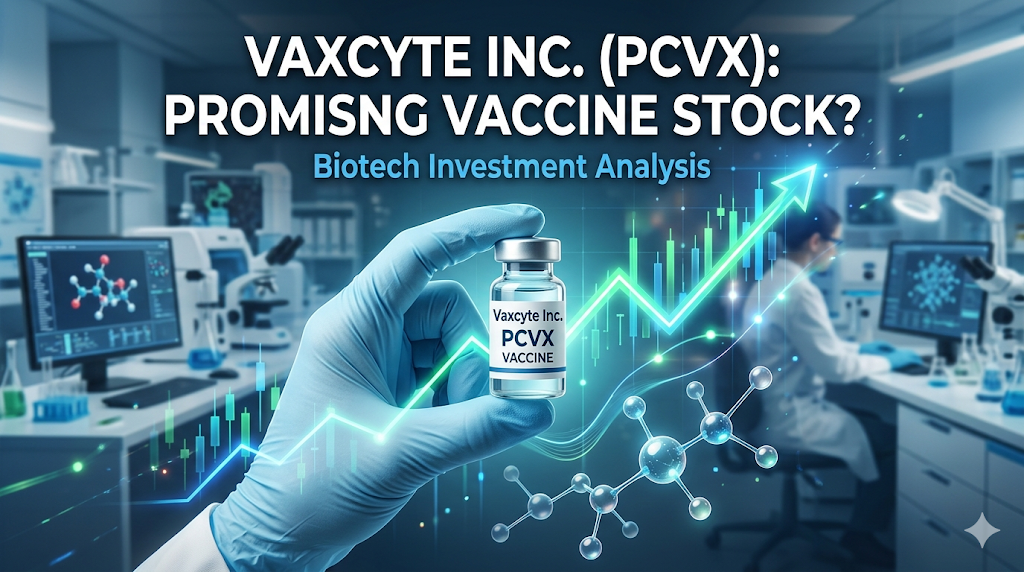
We recently published our article Top 5 Healthcare Stocks That Could Turn a $1000 Investment Into Something Bigger. To read the full article, head on to Top 10 Healthcare Stocks That Could Turn a $1000 Investment Into Something Bigger. In this piece, we take a closer look at Vaxcyte Inc. (NASDAQ:PCVX) to examine its latest developments, pipeline progress, and why it continues to draw attention from investors.
For much of the past three years, the US healthcare sector has looked like the quiet guest at a very loud Wall Street party. While artificial intelligence stocks, semiconductor names, mega-cap technology companies, and AI infrastructure plays grabbed most of the market’s attention, healthcare stocks were left sitting in the corner, looking unusually cheap, unusually unloved, and, depending on who one asks, unusually interesting.
That may now be the point.
The US healthcare sector has underperformed the broader stock market for three straight years, and the numbers tell the story clearly. Healthcare returned only 0.3% in 2023, followed by 0.9% in 2024, and 12.5% in 2025. Those returns may not sound disastrous in isolation, but compared with the broader market’s stronger gains, they show a sector that has struggled to keep up with investor enthusiasm elsewhere. The weakness has continued into 2026, with the healthcare sector down 1.62% year-to-date, while the S&P 500 has climbed 10.35% over the same period.
For investors searching for the best healthcare stocks to buy, undervalued healthcare stocks, promising healthcare stocks, biotech stocks with upside potential, medical device stocks, pharmaceutical stocks, healthcare value stocks, and defensive stocks with long-term growth potential, this kind of underperformance can be more than just a warning sign. It can also be the start of a setup.
The AI Trade Left Healthcare Behind
The biggest reason healthcare has lagged, according to several market watchers, is not that the sector suddenly lost its importance. People still need medicines, hospitals, diagnostics, medical devices, insurance coverage, drug development, and life-saving treatments regardless of what is trending on Wall Street. The problem is that healthcare has been competing for attention against one of the strongest market stories of the decade: artificial intelligence.
The AI trade has pulled enormous investor interest into technology, semiconductors, cloud computing, data centers, and AI infrastructure stocks. In a market where investors are chasing earnings growth tied to artificial intelligence, defensive sectors like healthcare can look less exciting, even when their fundamentals remain intact. That is exactly the point made by Gareth Powell, Head of Healthcare at Polar Capital, who argued in a May 18 article that investor enthusiasm for artificial intelligence has pulled capital away from defensive corners of the market, including healthcare.
Michael Zinn, Managing Director and Senior Portfolio Manager at UBS, made a similar observation during a June 8 appearance on BNN Bloomberg. Zinn described the market’s recent behavior as a “catch-up trade” tied to rising earnings expectations in AI infrastructure. In simpler terms, investors have been rewarding companies that appear directly connected to the AI boom, while skipping over sectors that look slower, steadier, or more defensive. Healthcare, despite its massive role in the economy, has been one of the sectors left behind.
That is one of the more interesting twists in today’s market. Healthcare is usually seen as a defensive sector, the kind investors often turn to when economic uncertainty rises. But in a market dominated by AI excitement, even defensive quality has not been enough to command investor attention.
Healthcare May Be Turning Into a Value Sector
This is where the story becomes more interesting for long-term investors. Jared Holz, a healthcare strategist at Mizuho Americas, has argued that the healthcare sector has effectively become a value sector. His reasoning is straightforward. After years of investors crowding into technology and AI-related stocks, healthcare valuations have become more reasonable, while expectations for many healthcare companies have fallen.
That combination matters. In the stock market, a sector does not always need perfect conditions to perform well. Sometimes, it only needs expectations to become low enough. When a sector is ignored for years, valuations can compress, investor sentiment can weaken, and even solid companies can trade below what analysts believe they are worth. That appears to be the situation now for several healthcare stocks with strong analyst upside potential.
For investors looking for healthcare stocks with high upside, Wall Street analyst stock picks, top healthcare stocks for 2026, and value stocks in the healthcare sector, the current setup may be worth studying closely. The sector’s underperformance has created a market where some healthcare companies may now offer more attractive risk-reward profiles than they did during periods when investors were more enthusiastic.
Healthcare has always been a broad sector. It includes pharmaceutical companies, biotechnology firms, hospital operators, managed care companies, diagnostics businesses, medical technology companies, life sciences tools providers, and healthcare services firms. Some of these companies are defensive and cash-generating. Others are higher-risk, catalyst-driven names tied to drug approvals, clinical trial results, regulatory decisions, and product launches. That mix gives investors several ways to approach the sector, depending on their risk appetite.
Why Wall Street Is Starting to Look Again
The renewed interest in healthcare stocks is not just about cheap valuations. It is also about history. SentimenTrader’s Jay Kaeppel has advised investors to put healthcare back on the radar, noting that the sector has rarely performed this poorly relative to the S&P 500. His view suggests that healthcare’s weak year-to-date showing may not be a reason to ignore the sector, but rather a reason to examine whether a rebound is becoming more likely.
That does not mean every healthcare stock is a bargain. It also does not mean investors should blindly buy the sector just because it has lagged. Healthcare investing can be complicated. Drugmakers face patent cliffs. Biotech companies face clinical trial risk. Medical device companies can be affected by hospital spending cycles. Managed care companies can be pressured by regulation, reimbursement trends, and utilization costs. Even large healthcare companies can struggle when policy uncertainty rises or growth expectations fall.
Still, the sector’s current position is hard to dismiss. Healthcare stocks have underperformed for several years, valuations appear more reasonable, and analyst price targets suggest that select names may have significant upside from current levels. For investors who believe the AI trade has become crowded, healthcare may offer a different kind of opportunity: less flashy, less crowded, but potentially more attractively priced.
There is also a useful bit of market trivia here. Healthcare is one of the few sectors that can be both defensive and innovative at the same time. A pharmaceutical company may generate steady revenue from established medicines while also developing next-generation therapies. A medical device company may serve everyday hospital demand while also introducing advanced technologies that improve surgery, imaging, or patient monitoring. A biotech company may look speculative today but become highly valuable if a major treatment succeeds. That is why healthcare often attracts both conservative investors and aggressive growth investors, even though they may be looking at very different types of companies.
The Sector Nobody Wanted May Now Be the One to Watch
The irony is that healthcare’s weakness may be exactly what makes it interesting now. Wall Street has spent years focusing on AI stocks, semiconductor stocks, mega-cap technology names, and companies tied to the digital infrastructure boom. Meanwhile, many healthcare stocks have been quietly reset. Expectations have moved lower. Valuations have become more reasonable. Analysts are starting to identify names with large upside potential. And the sector’s poor relative performance has become difficult to ignore.
For investors searching Google for the most promising healthcare stocks, best healthcare stocks according to Wall Street analysts, healthcare stocks with upside potential, undervalued biotech stocks, top pharmaceutical stocks, and healthcare stocks to buy now, the current market backdrop creates an important question: has healthcare been forgotten for too long?
That is the central idea behind this article. The healthcare sector is not suddenly risk-free, and not every beaten-down stock deserves a second look. But after three consecutive years of lagging the broader market and another weak start in 2026, the sector now sits in a position where Wall Street analysts see meaningful upside in select names. In a market where many investors are still chasing AI-linked winners, healthcare may offer something different: a mix of value, defensiveness, innovation, and recovery potential.
CHECK THIS OUT: Top 10 Small-Cap Biotech Stocks With Billion-Dollar Upside Potential and Top 10 Biotech Stocks That Could Climb as Much as 100%.
Our Methodology
In order to come up with our list of the top 10 healthcare stocks that could turn a $1,000 investment into something bigger, we used the Finviz stock screener to identify US-listed healthcare stocks with average analyst price targets at least 50% above their current share prices as of June 16, 2026, reviewed hedge fund ownership in Q1 2026 for added institutional context, and ranked the final list in ascending order of implied upside potential.
Top 5 Healthcare Stocks That Could Turn a $1000 Investment Into Something Bigger
2. Vaxcyte Inc. (NASDAQ:PCVX)
Stock Upside: 123.85%
Market Capitalization: $7.09 billion
Vaxcyte, Inc. (NASDAQ) ranks second among the most promising healthcare stocks according to Wall Street analysts, and Vaxcyte, Inc. (NASDAQ) brings a vaccine-development story with unusually large global health implications. Trading at $51.44, with Vaxcyte, Inc. (NASDAQ) up 1.52%, the company has a market capitalization of $7.09 billion and a stock upside of 123.85%. For investors searching for vaccine stocks, clinical-stage biotech stocks, infectious disease stocks, healthcare stocks with high upside, and Wall Street analyst healthcare picks, Vaxcyte, Inc. (NASDAQ) stands out because it is working on a disease area where no approved vaccine currently exists.
Vaxcyte, Inc. (NASDAQ) announced on June 2 that it had dosed the first participant in its Phase 1 first-in-human clinical trial of VAX-A1. Vaxcyte, Inc. (NASDAQ) is developing VAX-A1 as an experimental vaccine against Group A Streptococcus, also known as Group A Strep. For Vaxcyte, Inc. (NASDAQ), this first dosing marks an important transition from preclinical development into human testing. In biotech and vaccine development, first-in-human studies are major milestones because they begin to answer the basic questions of safety, tolerability, dosing, and immune response.
Vaxcyte, Inc. (NASDAQ) is entering a potentially significant global disease area. Vaxcyte, Inc. (NASDAQ) estimates that Group A Strep is responsible for around 800 million illnesses globally every year, with conditions ranging from common strep throat to severe, life-threatening infections and long-term complications such as rheumatic heart disease. Despite that disease burden, Vaxcyte, Inc. (NASDAQ) noted that no approved Group A Strep vaccine exists anywhere in the world. For investors following Vaxcyte, Inc. (NASDAQ), that is the core of the opportunity: a massive infectious disease burden with no approved vaccine solution.
Vaxcyte, Inc. (NASDAQ) plans to enroll 80 healthy adults aged 18 to 40 in Australia for the Phase 1 trial. Vaxcyte, Inc. (NASDAQ) said Australia was chosen because the country has high rates of Group A Strep disease and established research networks with strong expertise in studying it. For Vaxcyte, Inc. (NASDAQ), trial location is not just a logistical detail because vaccine studies benefit from regions where researchers understand the disease burden, patient population, and clinical monitoring needs.
Vaxcyte, Inc. (NASDAQ) will structure the trial in two stages. Stage 1 will include 12 participants who will serve as a safety checkpoint before an independent safety board reviews the results and decides whether Vaxcyte, Inc. (NASDAQ) can expand into Stage 2. All participants will receive two doses of VAX-A1 or placebo, spaced around two months apart, and Vaxcyte, Inc. (NASDAQ) will monitor them for six months after the final dose. The trial will also test low, mid, and high dose levels so Vaxcyte, Inc. (NASDAQ) can find the best balance between immune response and tolerability.
Vaxcyte, Inc. (NASDAQ) is a clinical-stage biotechnology company, and its vaccine work gives Vaxcyte, Inc. (NASDAQ) one of the more direct public-health stories on this list. With a $7.09 billion market capitalization, 57 hedge fund holders, and a 123.85% stock upside estimate, Vaxcyte, Inc. (NASDAQ) ranks near the top because Wall Street analysts see significant potential. For investors looking for vaccine stocks to watch, infectious disease biotech stocks, and healthcare stocks with major upside potential, Vaxcyte, Inc. (NASDAQ) has a clear thesis: a first-in-human vaccine candidate targeting a disease that affects hundreds of millions of people worldwide.
YOU MUST READ THIS: Top 10 Small-Cap Biotech Stocks That Could Surge 100%
Disclosure: No relevant interests to disclose. This article was originally published on BioTech HealthX.