At the center of modern neuroscience drug development is a company that helped define what large-scale biotechnology looks like in practice. Built around the idea that complex neurological diseases require equally sophisticated science, this enterprise emerged during the early wave of recombinant DNA innovation and grew into a global player by focusing on disorders of the brain, spinal cord, and immune system. From the beginning, its strategy revolved around translating deep biological insight into therapies that could alter the course of diseases once considered untreatable, particularly multiple sclerosis, spinal muscular atrophy, and neurodegeneration. That long institutional memory, combined with decades of regulatory, manufacturing, and commercialization experience, continues to shape how the company operates today in an increasingly competitive biopharmaceutical landscape.
Biogen Inc. (NASDAQ:BIIB) is headquartered in Cambridge, Massachusetts, and has spent more than four decades building a portfolio rooted in neuroscience and immunology. The company first established its reputation through pioneering work in multiple sclerosis, where it helped shift treatment paradigms from symptom management to immune modulation. Over time, Biogen developed and commercialized a series of disease-modifying therapies that generated billions in annual revenue and funded expansion into new therapeutic areas. This foundation allowed Biogen to evolve from a research-focused biotech into a fully integrated biopharmaceutical company with global manufacturing capabilities, extensive clinical trial infrastructure, and a presence across major healthcare markets worldwide.
As the company matured, Biogen increasingly focused on diseases driven by underlying biological mechanisms rather than single genetic defects. This approach is especially evident in its work on neurodegenerative disorders, where disease progression is influenced by protein aggregation, synaptic dysfunction, inflammation, and neuronal loss. In Alzheimer’s disease, for example, Biogen’s research has centered on amyloid-beta proteins that accumulate in the brain and disrupt neuronal communication. The science behind this approach is grounded in decades of research showing that soluble amyloid aggregates can trigger downstream neurotoxicity, ultimately impairing cognition and memory. By targeting these aggregates with monoclonal antibodies designed to bind and facilitate their clearance, Biogen aims to slow disease progression rather than simply treat symptoms.
The company has applied similar mechanistic thinking across its broader pipeline. In spinal muscular atrophy, Biogen’s work focuses on increasing production of survival motor neuron protein, which is essential for motor neuron health. This strategy reflects a deep understanding of RNA biology and splicing mechanisms, allowing therapies to address the root cause of neuronal degeneration. In rare epileptic and neuromuscular disorders, Biogen has explored antisense oligonucleotides and other precision approaches that modulate gene expression at the molecular level, demonstrating a commitment to platform technologies that can be adapted across multiple indications.
Financially, Biogen has historically distinguished itself from many biotechnology peers by generating sustained cash flows from approved products. This revenue base has enabled continued investment in research and development while supporting large-scale clinical trials that smaller companies often cannot afford. Even as competitive pressures and patent expirations have reshaped parts of its business, Biogen has maintained a focus on operational efficiency, manufacturing quality, and regulatory compliance, reinforcing its reputation as a disciplined operator within the biotechnology sector.
Today, Biogen operates at the intersection of established pharmaceutical scale and cutting-edge neuroscience research. Its background is defined not only by scientific ambition but also by the practical realities of developing therapies for some of the most complex diseases in medicine. That combination of long-term scientific investment, regulatory experience, and a willingness to adapt its strategy continues to define Biogen’s role in the global biopharmaceutical industry as it navigates the next phase of its evolution.
HSBC Downgrades Biogen as Royalty Dependency Comes Into Focus
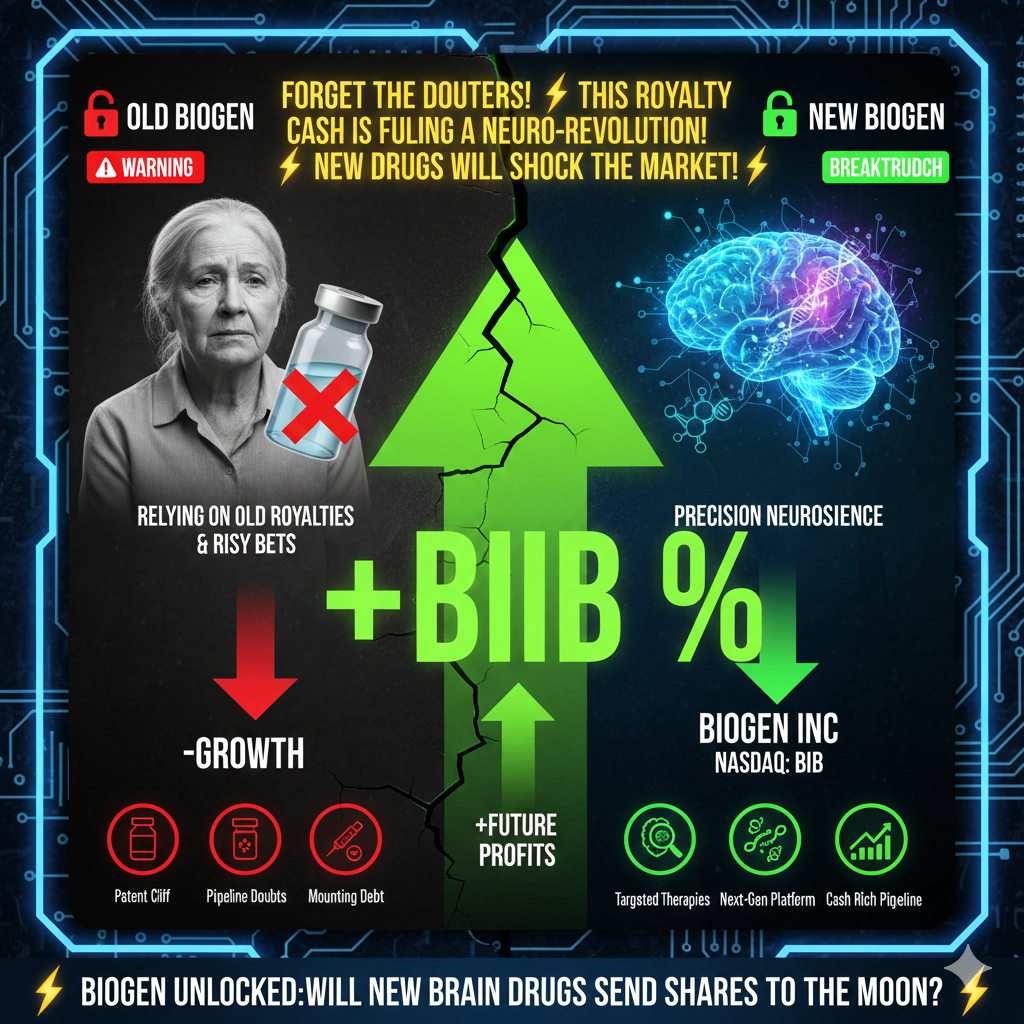
Biogen Inc. is back at the center of Wall Street debate after HSBC downgraded the stock from Hold to Reduce, citing structural concerns around the company’s long-term earnings profile despite its recent share price strength. The downgrade came as Biogen shares were trading at $175.84, close to their 52-week high of $185.17, underscoring the tension between near-term market momentum and longer-term fundamentals.
HSBC slightly lowered its price target on Biogen to $143.00 from $144.00, a level that implies roughly 20.6% downside from current prices. The firm characterized Biogen as a mid-rated biopharmaceutical company facing negative growth dynamics that are disproportionately tied to a royalty stream expected to decline toward the end of the decade. While the adjustment to the price target was modest, the shift in rating reflects a more cautious view on how Biogen replaces profit sources that have historically supported its margins.
READ ALSO: Tiziana (TLSA) Surges 143% in 2025 and Immuneering (IMRX) Reports 86% 9-Month Survival in Pancreatic Cancer.
Royalty Concentration and the CD20 Cliff
At the core of HSBC’s concern is Biogen’s reliance on CD20-related royalty income, which the firm estimates accounts for more than half of the company’s operating profit, assuming a near-100% royalty margin. These royalties, linked primarily to multiple sclerosis therapies commercialized by partners, are expected to begin declining from 2029 onward. HSBC adjusted its gross margin projections accordingly, modeling a gradual erosion as the royalty stream tapers off.
Despite this looming headwind, Biogen currently maintains a strong profitability profile. Over the last twelve months, the company reported a gross profit margin of approximately 76.56%, placing it among the more profitable large-cap biotechnology companies. HSBC’s analysis suggests that sustaining this margin will require either further cost realignment, which could suppress growth investments, or acceptance of margin compression as royalties fade.
Valuation Framework and Assumptions Behind the Downgrade
HSBC’s revised valuation is based on an adjusted present value methodology using a weighted average cost of capital of 7.5%, down from a prior assumption of 8.0%. The lower WACC reflects updated macro and ESG inputs rather than improved growth expectations. The model assumes a risk-free rate of 4.25%, an equity risk premium of 4.00%, a biopharma sector premium of 0.75%, and an ESG premium of 0.25%, reduced sharply from 1.00%. A beta of 0.80 was applied, consistent with Biogen’s relatively low volatility compared with smaller biotechnology peers.
The resulting $143 price target suggests that, in HSBC’s view, much of Biogen’s current valuation already discounts optimism around pipeline progress while underestimating the earnings gap created by the eventual decline in royalty income.
Balance Sheet Strength Offers Partial Cushion
While HSBC’s downgrade focuses on growth sustainability, it also acknowledges Biogen’s financial resilience. According to InvestingPro data, Biogen operates with a moderate level of debt, and its operating cash flows are sufficient to comfortably cover interest obligations. This balance sheet strength reduces near-term financial risk and gives management flexibility to pursue partnerships, internal pipeline development, or selective acquisitions.
This financial stability helps explain why Biogen shares continue to trade near cycle highs despite mixed analyst sentiment. Investors appear willing to pay for predictability and cash generation at a time when many biotechnology companies remain unprofitable or capital-constrained.
Pipeline Progress Continues to Offset Skepticism
Beyond the analyst downgrade, Biogen has remained active on the clinical and business development front. In collaboration with Stoke Therapeutics, the company recently presented long-term data for zorevunersen, an investigational antisense oligonucleotide for Dravet syndrome. The data showed durable seizure reductions alongside reported improvements in cognition and quality of life, reinforcing Biogen’s continued emphasis on rare neurological disorders.
Biogen has also expanded its research footprint through a partnership with Dayra Therapeutics to develop oral macrocyclic peptides targeting immunological conditions. The agreement included an upfront payment of $50 million, signaling Biogen’s willingness to deploy capital into earlier-stage innovation while maintaining optionality.
In Europe, regulatory momentum continues for the company’s neuromuscular franchise. The European Medicines Agency’s committee has recommended approval of a high-dose formulation of nusinersen for spinal muscular atrophy, with a final regulatory decision expected in January 2026. If approved, the higher-dose regimen could extend the commercial life of one of Biogen’s most important legacy products.
Market Reaction Reflects a Divided Narrative
The HSBC downgrade highlights a broader divide in how investors and analysts currently view Biogen. On one hand, the company trades near its 52-week high, supported by strong margins, balance sheet stability, and steady pipeline updates. On the other hand, questions remain about long-term growth once royalty streams diminish and whether newer assets can fully offset that decline.
For now, Biogen’s stock price suggests the market is prioritizing near-term earnings durability and pipeline optionality over longer-dated structural risks. Whether that confidence holds will likely depend on execution over the next several years, particularly as Alzheimer’s, rare disease, and immunology programs move through later-stage development.
Bottom Line for BIIB Stock
HSBC’s downgrade does not signal immediate financial distress for Biogen, but it does sharpen the focus on an issue that has lingered beneath the surface of the investment case: how the company replaces a high-margin royalty stream that has historically supported profitability. With shares trading well above HSBC’s revised valuation, future performance will hinge on Biogen’s ability to convert scientific progress into durable, diversified revenue growth before the end of the decade.
For investors, Biogen remains a case study in the trade-off between stability and reinvention within large-cap biotechnology, where strong cash flows today must ultimately give way to new engines of growth tomorrow.
READ ALSO: Tiziana (TLSA) Surges 143% in 2025 and Immuneering (IMRX) Reports 86% 9-Month Survival in Pancreatic Cancer.