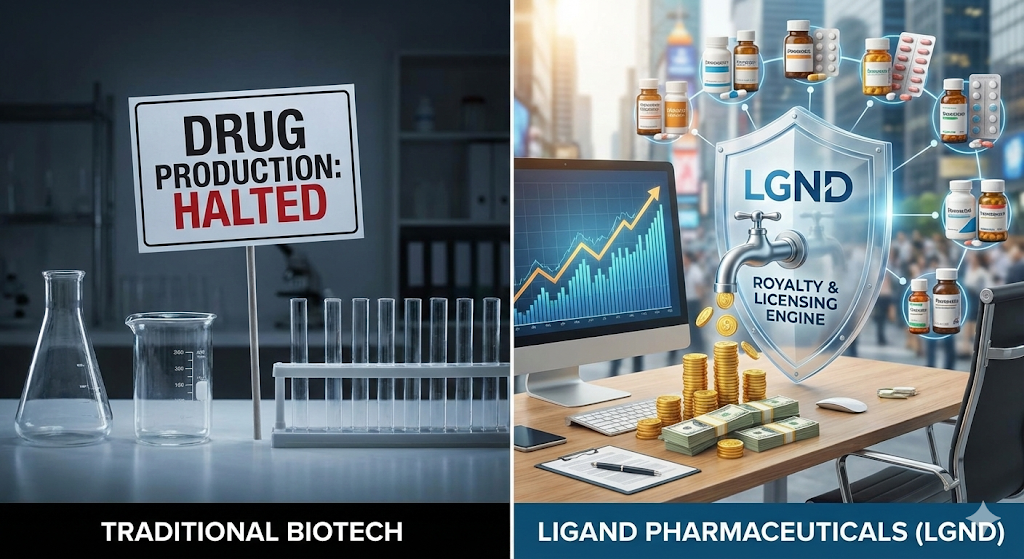
Ligand Pharmaceuticals (NASDAQ:LGND) was founded with the strategic idea that value in biotechnology does not only reside in owning drugs, but also in enabling their creation, delivery, and commercialization. From its earliest years, Ligand Pharmaceuticals, Inc. focused on building proprietary technologies, formulation platforms, and contractual frameworks that could be licensed to pharmaceutical partners, allowing those partners to shoulder the risks and costs of development while Ligand Pharmaceuticals, Inc. retained long-term economic participation through royalties and milestone payments.
This approach marked a fundamental departure from the classic biotech model. Rather than betting the company on a small number of internal drug candidates, Ligand Pharmaceuticals, Inc. chose to spread its exposure across dozens of programs by partnering with a wide range of biotechnology and pharmaceutical firms. This portfolio strategy allowed Ligand Pharmaceuticals, Inc. to diversify risk across therapeutic areas, development stages, and corporate partners, reducing dependence on any single clinical outcome while increasing the number of potential paths to success.
One of the defining elements of Ligand Pharmaceuticals, Inc.’s background is its development of Captisol, a drug delivery technology that improves the solubility and stability of certain pharmaceutical compounds. Captisol became a cornerstone of the company’s royalty portfolio, embedded in multiple approved drugs across different indications. This platform validated the company’s core thesis that enabling technologies can generate durable, recurring revenue without the need to commercialize drugs directly.
Over time, Ligand Pharmaceuticals, Inc. expanded beyond Captisol into a broader ecosystem of licensed assets, including intellectual property, development programs, and equity stakes in partner companies. This evolution transformed Ligand Pharmaceuticals, Inc. into a hybrid between a biotech company, a technology licensor, and a life sciences investment firm. The company’s background reflects this blend of science, finance, and strategic partnership rather than a single-track research or commercialization story.
As the biotech industry matured and competition intensified, Ligand Pharmaceuticals, Inc. continued refining its role as a capital-efficient participant in drug development. It selectively acquired royalty streams, invested in early-stage assets, and spun out or monetized holdings when appropriate, demonstrating a flexible approach to portfolio management that resembled asset allocation as much as traditional research and development.
The company’s location in San Diego placed it within one of the world’s most vibrant biotechnology ecosystems, giving it access to scientific talent, startup innovation, and strategic partners. This environment supported Ligand Pharmaceuticals, Inc.’s strategy of sourcing, evaluating, and partnering with a wide range of emerging biotech firms, further reinforcing its position as a central node within the broader pharmaceutical innovation network.
Another defining aspect of Ligand Pharmaceuticals, Inc.’s background is its emphasis on financial discipline and capital efficiency. By avoiding the massive costs associated with late-stage clinical trials, manufacturing facilities, and global sales organizations, the company maintained a lean operational structure while still participating in the economic upside of successful drugs. This allowed Ligand Pharmaceuticals, Inc. to generate cash flow, reinvest in new assets, and return capital to shareholders without relying on constant equity financing.
The company’s history is therefore characterized not by breakthrough discoveries or headline-grabbing drug approvals, but by steady accumulation of intellectual property, contractual rights, and strategic positions across the biotech landscape. Ligand Pharmaceuticals, Inc. became known not for a single therapeutic area, but for its role as a quiet beneficiary of innovation happening elsewhere in the industry.
As biotechnology shifted toward platform technologies, combination therapies, and increasingly complex drug delivery challenges, Ligand Pharmaceuticals, Inc.’s enabling approach grew more relevant. Pharmaceutical companies sought partners that could reduce development friction, accelerate time to market, and manage technical complexity, all of which aligned with Ligand Pharmaceuticals, Inc.’s long-standing focus.
Today, Ligand Pharmaceuticals, Inc. stands as a company whose background reflects a different way of participating in pharmaceutical innovation. It is neither a traditional drug developer nor a passive investor, but a hybrid entity built around the idea that owning pieces of many successful programs can be more resilient than owning all of one.
That background defines both the company’s appeal and its uniqueness. It is a story of building value through infrastructure, partnerships, and long-term contractual participation rather than direct commercialization. It is the story of a biotech company that chose to operate in the shadows of drug development rather than on the stage, and in doing so created a business model that is deeply embedded in the modern pharmaceutical ecosystem.
Ligand Pharmaceuticals Is Being Framed as a Low-Risk Royalty Compounder, but the Market May Be Underestimating the Structural Risks
Ligand Pharmaceuticals, Inc. is increasingly marketed as a “safe” way to invest in biotech because of its royalty-based business model, diversified program portfolio, and lack of direct exposure to late-stage clinical failures. The narrative is appealing. The company earns revenue from dozens of partnered programs, avoids the capital intensity of drug development, and benefits from blockbuster drug sales without bearing manufacturing or marketing risk. On paper, this makes Ligand Pharmaceuticals look like a capital-light, high-margin biotech compounder.
But when this model is examined more closely, the very attributes that make Ligand attractive in bullish narratives also form the foundation of a long-term bearish thesis. The company’s dependence on partners, its exposure to royalty concentration, its sensitivity to patent cycles, and the structural limits of its growth model create risks that are not obvious in headline revenue growth or analyst price targets.
CHECK THIS OUT: Here’s Why Apogee Therapeutics (APGE) Is Suddenly on the Radar of Biotech Investors and Coeptis Therapeutics (COEP) Is Not Profitable Yet — and That’s Exactly Why It’s Interesting.
The Royalty Model Shifts Risk Rather Than Eliminating It
Ligand Pharmaceuticals does not eliminate risk by outsourcing development, manufacturing, and commercialization. It transforms risk into dependency.
Every dollar of Ligand’s revenue ultimately comes from the performance of other companies’ products. That means Ligand has little control over pricing decisions, marketing investment, sales execution, geographic expansion, or competitive response. If a partner underinvests in a product, loses market share, faces regulatory setbacks, or deprioritizes a program internally, Ligand’s revenue can suffer even if the underlying science remains sound.
This creates a situation where Ligand Pharmaceuticals stock becomes a proxy not for one business, but for dozens of external businesses, each with their own risks, incentives, and strategic agendas. That makes revenue quality harder to evaluate and future cash flows more uncertain than they appear.
The company’s growing royalty base does not guarantee stability. It creates complexity.
Revenue Growth Looks Strong, but It Is Built on a Fragile Foundation
Ligand’s reported doubling of royalty revenue since 2022 and its forecast of 40 percent royalty growth in 2026 sound impressive. But these figures must be understood in context.
Royalty revenue is inherently volatile because it is tied to product life cycles. Drugs experience launch ramps, peak sales periods, competitive erosion, patent expiration, and eventual decline. A portfolio of royalties smooths this cycle only if new products consistently replace aging ones at scale.
That is not guaranteed.
If several major royalty products approach maturity simultaneously or face generic competition earlier than expected, Ligand could experience revenue stagnation or decline despite having dozens of programs in development. Development-stage programs do not generate revenue until years later, if ever. That creates a timing mismatch between declining mature royalties and uncertain future ones.
The appearance of stability masks a long-term reinvestment treadmill.
Concentration Risk Is Higher Than It Appears
Although Ligand promotes its portfolio as diversified across more than eighty development programs and a dozen commercial-stage products, a meaningful portion of revenue is still concentrated in a relatively small number of assets.
If even one or two of the highest royalty-generating drugs underperform expectations, the impact on financial results can be material. In contrast, truly diversified revenue models such as software subscriptions or broad consumer portfolios do not face such binary dependence on the success of individual assets.
In biotech, even commercial-stage drugs are vulnerable to rapid displacement by superior therapies, pricing pressure from payers, or safety concerns that emerge post-approval.
Royalty diversification reduces risk compared to single-asset companies, but it does not remove it.
Growth Expectations May Be Too Optimistic
Management’s projection of 23 percent compound annual growth in royalty revenue through 2030 implies sustained success across multiple programs over several years. This assumes not only that existing products grow and hold market share, but that a steady pipeline of new launches occurs without meaningful delays or failures.
This is an aggressive assumption in a sector defined by regulatory uncertainty, clinical risk, and competitive disruption.
Even large pharmaceutical companies with massive R&D budgets struggle to maintain that level of consistent growth across multiple years. For a royalty aggregator dependent on external execution, the hurdle is even higher.
The risk is not that growth stops entirely. The risk is that it falls short of expectations, and when expectations are high, valuation becomes vulnerable.
Valuation Risk Is Rising as the Narrative Improves
Ligand’s market capitalization has nearly tripled in three years, reflecting rising investor confidence in the royalty model. As confidence increases, so does valuation risk.
At higher valuation multiples, the margin of safety shrinks. Any disappointment in revenue growth, royalty concentration, or partner execution can lead to sharp repricing.
This is especially true in biotech, where sentiment can swing quickly and valuation multiples can compress rapidly when growth narratives weaken.
In this sense, the more Ligand is marketed as a safe biotech compounder, the more dangerous it becomes if reality proves less smooth than projected.
Analyst Optimism May Lag Business Risk
Seven of eight analysts rating Ligand as a strong buy reflects consensus optimism, not necessarily risk-adjusted reality. Analyst models are built on management guidance, pipeline assumptions, and partner execution timelines that are inherently uncertain.
When many analysts share the same optimistic assumptions, downside risk increases because the market becomes crowded on one side of the trade.
In other words, strong consensus can be a contrarian risk signal rather than a validation.
The Strategic Ceiling of the Royalty Model
There is also a strategic limit to how large Ligand can become within its current model.
It does not own products. It does not control pricing. It does not control commercialization. It cannot fully capture upside when a product becomes a blockbuster.
It participates in success but does not own it.
That means its long-term growth potential is structurally capped relative to companies that build and commercialize their own franchises. This makes Ligand more like a financial aggregator than a compounding product company.
That distinction matters when investors assign growth multiples.
The Bearish Conclusion on Ligand Pharmaceuticals
Ligand Pharmaceuticals is not a bad company. It is a well-run, capital-efficient, and intelligently structured biotech business.
But that does not make it a low-risk investment.
Its revenue depends on partners it does not control. Its growth depends on product cycles it cannot manage. Its valuation depends on optimistic projections about sustained multi-year royalty expansion. Its perceived safety rests on diversification that may be thinner than it looks.
In short, Ligand has shifted risk away from clinical failure and toward structural dependency, revenue volatility, and valuation fragility.
That is not the absence of risk. It is a different form of risk.
And in an environment where the stock is already pricing in strong growth, high confidence, and continued execution, that form of risk may be more dangerous than it appears.
That is the core of the bearish thesis for Ligand Pharmaceuticals, Inc.
READ ALSO: Could UnitedHealth Group (UNH) Be the Safest Way to Invest in Healthcare Growth? and SELLAS Life Sciences Group (SLS) Just Took a Big Step Toward Changing How Cancer Is Treated.