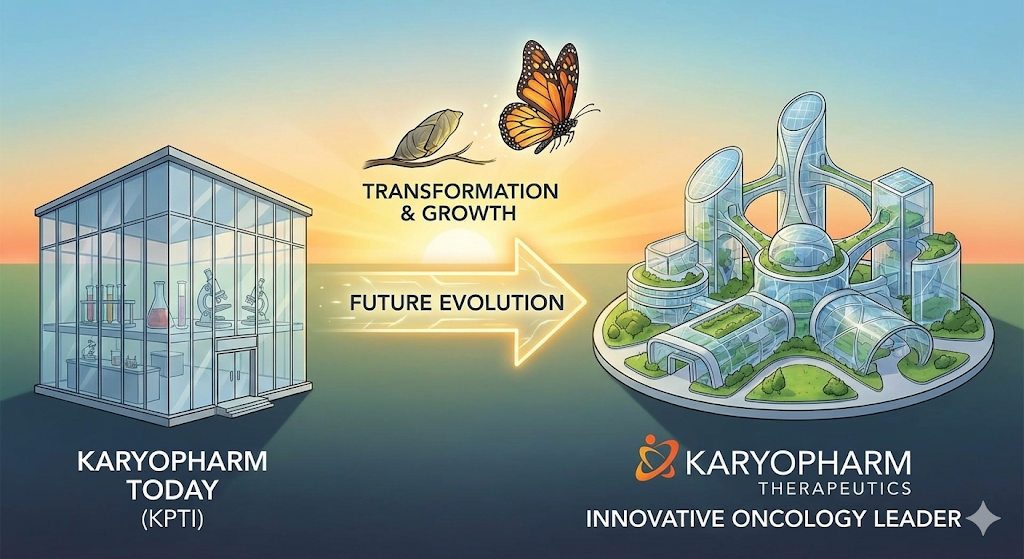
What began as a focused scientific effort to understand one of cancer’s most fundamental biological mechanisms gradually evolved into a commercial oncology enterprise operating at the intersection of molecular biology, drug development, and global healthcare delivery. The company was built around the idea that many cancers share a common vulnerability in how they regulate proteins inside the cell, and that targeting this process could unlock new therapeutic possibilities across multiple tumor types. From its earliest days, the organization prioritized deep scientific rigor over rapid commercialization, assembling teams of biologists, chemists, and clinicians to pursue a platform rather than a single product, laying the groundwork for a long-term presence in the oncology biotech industry.
Karyopharm Therapeutics (NASDAQ:KPTI) was founded in 2008 with the explicit goal of developing novel oral cancer therapies that address nuclear export dysregulation, a process increasingly recognized as a driver of tumor growth and resistance to treatment. Rather than focusing on traditional cytotoxic drugs or narrowly targeted inhibitors, Karyopharm Therapeutics Inc. concentrated on exportin 1, or XPO1, a protein responsible for transporting key regulatory molecules out of the cell nucleus. This scientific focus led to the creation of a new drug class known as Selective Inhibitors of Nuclear Export, establishing the company as a pioneer in an entirely new therapeutic category within oncology.
As research progressed from discovery into clinical development, Karyopharm Therapeutics Inc. demonstrated that its approach could translate into real clinical benefit. The company advanced its lead compound, selinexor, through early-stage trials and into late-stage development, ultimately achieving regulatory approvals in multiple indications. This transition from laboratory science to commercial medicine marked a defining moment in the company’s history, transforming it from a research organization into a commercial-stage pharmaceutical company with global reach.
Over time, Karyopharm Therapeutics Inc. expanded its presence beyond the United States, securing regulatory approvals and commercial partnerships across Europe, the United Kingdom, China, and other international markets. This global expansion allowed the company to diversify revenue sources, broaden patient access, and integrate into multiple healthcare systems, strengthening its position as a worldwide oncology innovator rather than a regionally confined biotech firm.
Karyopharm Therapeutics Inc. also distinguished itself by maintaining a focused and coherent pipeline strategy. Rather than chasing every possible indication, the company concentrated on cancers with high unmet need and strong biological rationale for XPO1 inhibition, including multiple myeloma, endometrial cancer, myelofibrosis, and diffuse large B-cell lymphoma. This disciplined approach allowed the organization to allocate resources efficiently while building a pipeline that reflects both scientific credibility and commercial relevance.
Throughout its evolution, Karyopharm Therapeutics Inc. has balanced innovation with execution, building not only a research engine but also the regulatory, manufacturing, and commercial infrastructure required to deliver medicines to patients. This includes establishing quality systems, supply chains, medical affairs teams, and market access capabilities that are essential for long-term success in the pharmaceutical industry but often underappreciated in early-stage biotech narratives.
Today, Karyopharm Therapeutics Inc. stands as a hybrid entity that blends platform science with commercial execution. Its background is defined not by a single breakthrough, but by a steady progression from discovery to development to global commercialization. The company’s history reflects a long-term commitment to building durable value through scientific differentiation, clinical validation, and disciplined expansion, positioning it as a meaningful participant in the evolving landscape of oncology drug development rather than a short-lived product story.
In this context, Karyopharm Therapeutics Inc. is best understood not simply as the maker of a single cancer drug, but as an organization built around a mechanistic insight into cancer biology that continues to inform its research, pipeline, and strategic direction. Its background illustrates how sustained focus on a core scientific principle can evolve into a commercial enterprise with global impact, making it a distinctive presence within the broader biotechnology and pharmaceutical ecosystem.
A Commercial-Stage Oncology Company Quietly Building a Durable Franchise
Karyopharm Therapeutics Inc. stands in a rare position within the biotechnology sector. It is neither an early-stage science experiment nor a mature pharmaceutical giant struggling to grow. Instead, it occupies a valuable middle ground as a commercial-stage oncology company with an approved drug, a scientifically differentiated platform, and multiple late-stage pipeline programs targeting high-unmet-need cancers. This combination creates a unique investment profile in which revenue exists today, while substantial upside remains embedded in clinical and regulatory progress.
The foundation of this positioning lies in Karyopharm’s long-standing focus on nuclear export dysregulation, a fundamental biological process implicated in cancer progression. Rather than competing in crowded fields with incremental therapies, Karyopharm has built its scientific identity around targeting exportin 1, or XPO1, a protein responsible for transporting tumor suppressors and growth regulators out of the nucleus. By inhibiting this pathway, Karyopharm’s drugs aim to restore normal cellular control mechanisms, offering a mechanistically novel approach to cancer treatment.
This is not an abstract scientific claim. It has already translated into a real commercial product with global approvals, creating both validation of the platform and a revenue engine that supports continued development.
CHECK THIS OUT: Here’s Why Apogee Therapeutics (APGE) Is Suddenly on the Radar of Biotech Investors and Coeptis Therapeutics (COEP) Is Not Profitable Yet — and That’s Exactly Why It’s Interesting.
Selinexor and the Validation of the XPO1 Platform
The approval and commercialization of XPOVIO, known as selinexor, marked a critical milestone in Karyopharm’s evolution. As the first-in-class oral XPO1 inhibitor, selinexor established Karyopharm not only as a drug developer but as the originator of an entirely new therapeutic category. This matters because category creators often enjoy long-lasting strategic advantages, including clinical mindshare, regulatory familiarity, and intellectual property protection.
Selinexor is approved in the United States for multiple oncology indications and has received regulatory approvals across more than fifty ex-U.S. markets, including the European Union, the United Kingdom, and China. This global footprint is strategically important. It diversifies revenue sources, reduces dependence on a single healthcare system, and positions the company to benefit from expanding access to cancer treatments in emerging markets.
The existence of a marketed product also fundamentally changes the financial profile of Karyopharm Therapeutics stock. Unlike development-stage biotechs that rely entirely on capital markets to fund operations, Karyopharm generates product revenue and royalties that partially offset R&D costs. This reduces dilution risk, strengthens the balance sheet, and gives management greater flexibility in timing and structuring future financing.
Pipeline Expansion and the Next Wave of Value Creation
While selinexor provides the foundation, the real upside in Karyopharm’s valuation lies in the expansion of that franchise into new, larger, and earlier-line indications. The company is actively advancing late-stage clinical programs in myelofibrosis, endometrial cancer, multiple myeloma, and diffuse large B-cell lymphoma, each representing significant unmet medical needs and sizable commercial opportunities.
The Phase 3 SENTRY trial in myelofibrosis is particularly important because it targets a disease area where treatment options remain limited and outcomes remain poor for many patients. A successful readout would position selinexor not as a niche salvage therapy, but as a core component of front-line or combination regimens. That transition from later-line to earlier-line use is often where oncology drugs achieve their largest commercial impact.
Similarly, the exploration of selinexor in endometrial cancer and DLBCL reflects a strategic push into solid tumors and aggressive hematologic malignancies, expanding the addressable patient population and diversifying the company’s clinical risk across multiple programs.
The Inducement Grants as a Signal of Organizational Momentum
The recent announcement of inducement stock grants to newly hired employees under Nasdaq Listing Rule 5635(c)(4) might appear trivial at first glance, but in the context of biotechnology company dynamics, it carries meaningful signaling value. The grants indicate that Karyopharm is actively recruiting new talent and investing in human capital at a stage when many small biotechs are shrinking or freezing hiring.
This suggests confidence from management in the company’s trajectory, pipeline progress, and long-term growth prospects. Companies that expect contraction do not expand their teams. Companies preparing for regulatory filings, commercial expansion, or late-stage trial execution do. In this sense, the inducement grants serve as a subtle but important confirmation that Karyopharm is not retrenching, but building.
Furthermore, the structured three-year vesting schedule aligns employee incentives with long-term value creation, reinforcing a culture focused on sustained execution rather than short-term stock price movements.
A Platform Strategy Rather Than a Single-Drug Bet
One of the most underappreciated aspects of Karyopharm Therapeutics is that it is not merely a selinexor company. It is an XPO1 platform company. That distinction matters because platforms can generate multiple assets, combinations, and lifecycle extensions over time.
The scientific rationale for XPO1 inhibition extends beyond a single molecule, opening the door to next-generation compounds, optimized dosing strategies, and combination regimens with other therapies such as immunotherapies, targeted agents, and chemotherapies. This platform approach increases the probability that Karyopharm can sustain relevance and growth even as the competitive landscape evolves.
Market Mispricing and the Opportunity for Re-Rating
Despite its commercial product, global approvals, late-stage pipeline, and differentiated science, Karyopharm Therapeutics stock often trades like a high-risk development-stage biotech rather than a company transitioning into a multi-product oncology franchise. This creates a valuation disconnect that can persist until catalysts force a re-rating.
Those catalysts are visible. They include pivotal trial readouts, potential regulatory submissions, label expansions, and continued revenue growth from existing indications. Each of these events has the potential to materially change market perception of risk and future cash flows.
As that perception changes, valuation can shift rapidly, particularly in biotechnology where binary events often trigger repricing.
The Bullish Conclusion
The bullish thesis for Karyopharm Therapeutics Inc. is grounded in the convergence of scientific differentiation, commercial validation, pipeline depth, and organizational momentum. The company has already proven that its platform works in patients, that regulators will approve its therapies, and that clinicians will adopt them. It is now in the phase of scaling that success into broader indications and larger patient populations.
This is the phase where biotechnology companies often transition from speculative investments into established growth stories. The market has not fully priced that transition yet.
For investors looking for exposure to oncology innovation, platform science, and late-stage clinical catalysts within a commercial-stage company, Karyopharm represents a rare combination of reduced downside risk and meaningful upside potential. That asymmetry is what makes the story compelling, and why Karyopharm Therapeutics stock remains one of the more interesting under-the-radar opportunities in the oncology biotech space today.
READ ALSO: Could UnitedHealth Group (UNH) Be the Safest Way to Invest in Healthcare Growth? and SELLAS Life Sciences Group (SLS) Just Took a Big Step Toward Changing How Cancer Is Treated.