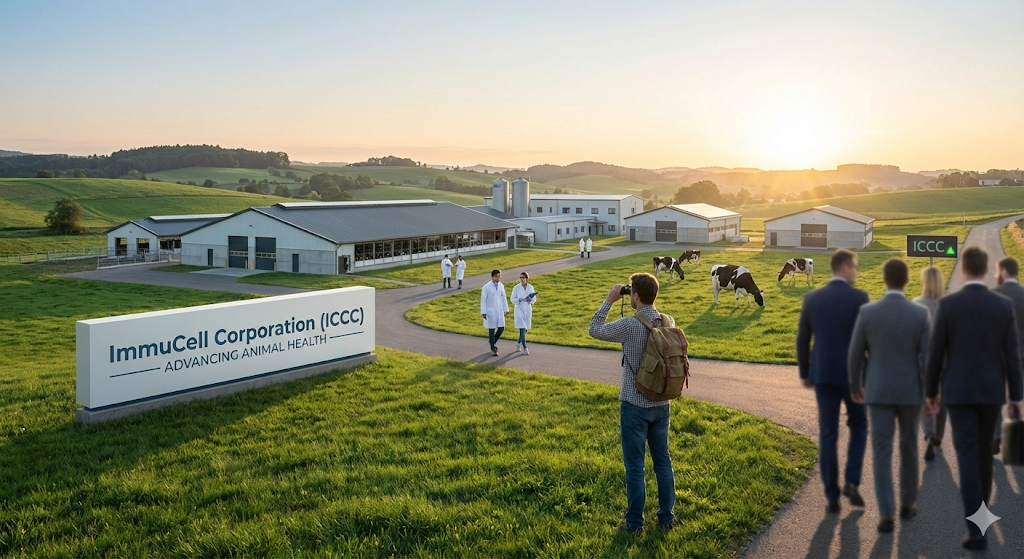
In the animal health sector, where farmers and producers buy results more than stories, a small-cap name has quietly built a long-running niche by making practical products that protect calves, support dairy and beef cattle operations, and translate science into measurable improvements in health and productivity.
ImmuCell Corporation (NASDAQ:ICCC) is an animal health company that develops, manufactures, and markets animal health products designed to improve the health and productivity of dairy cows and beef cattle, with a business identity anchored in repeatable field outcomes rather than one-time breakthroughs. ImmuCell Corp has historically emphasized a manufacturing-driven operating culture, meaning the company’s background is shaped as much by laboratory and manufacturing equipment, quality systems, and production discipline as it is by branding and sales. That matters in animal health because producers value reliability: when a product is integrated into routines for newborn dairy and beef calves, consistency of supply and quality becomes part of the product’s value, not an afterthought.
ImmuCell has built its commercial foundation around First Defense, a flagship line associated with immediate immunity in calves and long-standing leadership in scours prevention. The company’s background is deeply linked to this franchise because scours is one of the most economically important early-life health challenges for calves in dairy and beef settings, and prevention-focused products tend to become habitual purchases when they work. ImmuCell manufactures and sells products that are designed to create scientifically proven protection during the critical window when calves are most vulnerable, and that long-term focus on protection and health has helped shape its reputation as a supplier of practical products for farms that prioritize survival rates, early growth, and downstream productivity. Over time, First Defense has become not just a product name but a strategic anchor for the company’s brand, its customer relationships, and its understanding of how to deliver value to producers who need solutions that are simple, fast, and dependable.
ImmuCell’s background also reflects an organization that has repeatedly had to balance innovation with execution risk, especially when navigating FDA-facing development work that requires rigorous manufacturing and documentation standards. In pursuing new animal health opportunities, the company has had to manage technical risk and capital expenditure decisions the way a disciplined manufacturer would: investing in manufacturing equipment where it improves control and quality, using a proprietary process internally where that adds value, and selectively leveraging contract manufacturer relationships where that can reduce capital expenditure and limit technical risk. This operational mindset is an important part of the ImmuCell Corporation story because it explains why the company can behave differently from many small growth names. It tends to think in terms of process stability, quality, and scalable production rather than purely in terms of “pipeline excitement.”
ImmuCell’s track record in manufacturing discipline has been reinforced by its experience working through regulated requirements tied to the United States Food and Drug Administration, including the reality that FDA inspection outcomes and inspectional deficiencies can reshape timelines even when a company believes the science is ready. For investors who follow ICCC as a Nasdaq-listed equity, this aspect of the background matters because it highlights why management frequently speaks in the language of reducing technical risk, avoiding open-ended further investment, and prioritizing the assets that can produce the strongest return. ImmuCell’s leadership has framed its decision-making around practical implications, including how contracts, pending expiration dates, and vendor compliance can affect progress, which is consistent with a company that has learned to protect long-term value by avoiding unnecessary operational traps.
ImmuCell Corp’s corporate identity has also been shaped by its role as both a developer and a manufacturer, not just a marketer. ImmuCell manufactures products that rely on specialized inputs and careful handling, which is why investments in laboratory and manufacturing equipment are part of the company’s long-term value creation. In animal health, customers rarely care about internal processes unless something fails, but consistent quality is what earns repeat business, and repeat business is what builds a durable animal health company. That is why the ImmuCell Corporation narrative naturally includes concepts like manufacturing equipment, aseptic filling requirements when relevant, and the importance of ensuring all technical sections and documentation expectations can be met when pursuing FDA approvals in the animal health products category.
ImmuCell’s evolution has also included building an organizational capacity to assess opportunities, complete ongoing investigational studies when needed, and adapt claims strategy in response to market realities and regulatory pathways. That adaptability is part of the company’s background because it signals a willingness to protect capital and prioritize the core business when new programs introduce outsized uncertainty. ImmuCell’s approach has frequently centered on reducing capital expenditure exposure while still maintaining optionality through licensing discussions with interested parties or potentially partnering with a global manufacturer when that structure is more efficient than building everything in an own facility. For a small-cap company, this is a meaningful part of the story because it reflects an understanding of scale: knowing what must be owned internally, what can be outsourced, and what should be monetized through partnership to preserve cash and reduce ongoing risk.
ImmuCell Corporation’s brand equity with producers is fundamentally tied to credibility. In dairy and beef markets, credibility is earned by showing up year after year with products that protect calves, support herd health, and improve outcomes that producers can see without needing a microscope. That is why the company’s background often circles back to scours prevention and the practical promise of immediate immunity in newborn dairy and beef calves. These are not abstract needs; they are everyday realities for farms. ImmuCell’s long-term focus on health, defense, protection, and productivity has made it an identifiable name in the animal health space, and that reputation is reinforced by the fact that its business model is built to serve both dairy cows and beef cattle operations with solutions designed to fit real workflows.
For investors and industry watchers, ImmuCell Corp stands out as an animal health company that has learned to treat manufacturing quality as a growth driver, not a cost center. The company’s background includes the operational discipline to limit technical risk, the strategic restraint to avoid endless further investment when timelines become uncertain, and the commercial understanding that the best animal health products are the ones that become routine. In a sector where many small companies struggle to connect innovation to sustained sales, ImmuCell Corporation has built a reputation on doing exactly that: creating scientifically proven, practical products that improve cattle health and productivity while maintaining a manufacturing-first mindset that supports long-term durability.
ImmuCell Corp (NASDAQ:ICCC) pivots with urgency: an FDA “Incomplete Letter” becomes the catalyst for a First Defense expansion push
ImmuCell Corp has built its identity as an animal health company that lives in the real economy of dairy and beef cattle, not in abstract promises. The company’s history is rooted in developing, manufacturing, and marketing practical animal health products that improve cattle health and productivity, and that operating DNA is exactly why investors keep coming back to ImmuCell Corporation when the sector is noisy. In animal health, what matters most is whether a product can be delivered consistently, whether it protects outcomes that producers can measure, and whether it can scale without ballooning technical risk and capital expenditure. That is the lens through which the latest strategic change should be understood, because the story here is not simply “good news” or “bad news.” The story is execution, and what management chose to do when faced with delays it could not control.
On December 24, 2025, ImmuCell Corporation disclosed that it received an Incomplete Letter from the United States Food and Drug Administration (FDA) on December 23, 2025 for its Re-Tain New Animal Drug Application (NADA). At the exact same time, ImmuCell announced it would increase its First Defense field sales force by 50% and expand its First Defense manufacturing capabilities. In finance-news terms, that is a clean headline moment: an FDA-related obstacle hits one program, and management immediately reallocates resources toward the franchise that already leads its category. This kind of pivot matters because it signals that the company is prioritizing return on capital, reducing the need for uncertain spending, and pushing harder on the asset that already has market validation in scours prevention.
CHECK THIS OUT: Corcept (CORT) Skyrockets 1,534% in 10 Years and Immuneering (IMRX) Reports 86% 9-Month Survival in Pancreatic Cancer.
What actually happened with Re-Tain: four complete technical sections, one manufacturing section that became the bottleneck
To understand why this pivot is rational, you have to understand how ImmuCell structured its Re-Tain approval attempt. ImmuCell said it received Complete Letters from the FDA for four of the five Technical Sections required for NADA approval. The remaining fifth technical section was the one tied to manufacturing, and that’s where operational reality collided with timeline expectations. ImmuCell had pursued a two pronged manufacturing approach designed to reduce capital expenditure and limit technical risk, precisely because building everything internally can be expensive and technically complex, especially when aseptic filling is involved.
Under that approach, ImmuCell manufactured the active pharmaceutical ingredient using a proprietary process inside its own facility, then hired an experienced contract manufacturer with FDA approvals for animal health products for the aseptic filling of the product into syringes. The detail that matters for investor perception is that ImmuCell passed FDA inspection of its own facility in 2024. That’s a credibility point for internal quality and manufacturing discipline. But the FDA’s position, as described by the company, was that it was declining to approve the NADA because the contract manufacturer had not satisfactorily addressed inspectional deficiencies. This is the kind of “vendor dependency” risk that can trap small companies into spending more and more money while timelines stretch. It becomes a classic capital sink unless management has the discipline to stop.
ImmuCell then highlighted the practical implications of resulting delays, including the pending expiration of ImmuCell’s contract with the manufacturer in March 2026. That contract clock matters. When a contract is close to expiring, a company can end up forced into a worse negotiating position, or forced into a rushed and expensive pivot to a new manufacturer, or forced into continuing spend to keep the process alive. ImmuCell chose a fourth path: pause further investment in Re-Tain and redeploy resources to First Defense.
Why the pivot can be bullish: it reduces technical risk and preserves cash while accelerating the proven franchise
A lot of companies say they are “disciplined.” ImmuCell Corp showed it in a concrete way. Instead of doubling down on further investment into a delayed manufacturing path, the company explicitly decided to reduce technical risk and reallocate resources to what it called its highest return opportunity: First Defense. That matters because investors can model First Defense growth more plausibly than they can model a regulatory timeline that hinges on a third party’s ability to satisfy inspectional deficiencies.
ImmuCell Corporation’s language around First Defense is not vague. It is centered on category leadership, scours prevention demand, and a total addressable market that management put at an estimated $900 million worldwide for preventing scours in calves. When a company tells you it is building capacity for a market of that size, and simultaneously expands the field sales force by 50%, it is essentially betting that its product-market fit is already strong and that the constraint is reach and supply, not demand.
The “immediate immunity” theme sits at the center of that fit. First Defense is positioned to provide antibody-based protection for calves at the earliest stage, when newborn dairy and beef calves are highly vulnerable. Scours is not just a health issue; it is a productivity issue, because scours can lead to dehydration, poor growth, higher treatment costs, and higher mortality risk. That is why scours prevention remains a priority for dairy cows and beef cattle operations, and why practical products that are easy to deploy get adopted faster than complicated protocols.
First Defense’s market strength: category leadership, spending share, and the compound-growth track record
ImmuCell Corp has argued that First Defense holds strong leadership in the U.S. market, supported by its #1 ranking for scour-prevention in the 2025 Hoard’s Dairyman Continuing Market Study and its 29% share of U.S. spend on scours prevention. Those two facts, taken together, imply that the product is not merely present; it is one of the default choices in the category. For investors, that’s important because it reduces commercial uncertainty. When a product already has a meaningful share of spend, expanding sales coverage often produces a more predictable return than launching a brand-new product into a cold market.
ImmuCell’s Board Chair added another financially relevant data point that frames this pivot as a compounding story rather than a one-off reaction. The Board described how a small field team established years ago helped grow First Defense annual revenue from approximately $4.4 million to approximately $27.8 million in the trailing twelve-month period ended September 30, 2025, and highlighted more than 13% compounded growth per year for more than a decade. That long stretch of compounding is exactly what makes it rational to invest further in sales execution and manufacturing scale, because it implies that the franchise has maintained relevance across multiple market cycles.
The manufacturing plan: repurposing equipment, expanding capacity, and lowering costs through a multi-year program
The other half of the bullish thesis is manufacturing, because in animal health, the ability to manufacture at scale with consistent quality is what unlocks both top-line growth and margin expansion. ImmuCell said it is expanding First Defense manufacturing capabilities and starting a multi-year manufacturing improvement program to lower product costs, improve manufacturing yields, and execute the next phase of capacity expansion. Those three phrases are not corporate filler. Lowering costs increases gross margin. Improving yields reduces waste and strengthens supply reliability. Expanding capacity prevents stockouts and allows sales teams to push without worrying that demand creation will outpace supply.
This is also where the Re-Tain shift becomes financially “clean.” ImmuCell expects to record a non-cash impairment write-down of property, plant and equipment during the fourth quarter of 2025 as a result of the strategic change in focus. As previously disclosed, the net book value of Re-Tain assets was approximately $15.5 million as of September 30, 2025, and the company anticipated adjustments to laboratory and manufacturing equipment and construction in progress, resulting in an estimated non-cash impact to profit of approximately $2.3 million. The key phrase for investors is “non-cash.” It can hit reported earnings, but it does not directly drain cash in the same way incremental capital expenditure would. More importantly, the CFO said the company plans to repurpose facilities and a large portion of the equipment for the expansion of First Defense capacity to maximize return on these assets. That is exactly how you turn a write down narrative into a redeployment narrative.
Re-Tain doesn’t vanish; it becomes a smarter option: complete studies, improve claims, then license or partner
A disciplined pivot is not necessarily a surrender. ImmuCell said it will complete ongoing investigational studies with Re-Tain to assess opportunities for an improved set of claims for preventing and treating mastitis in dairy cows, including subclinical mastitis. That matters because “claims” are the commercial language of animal health; stronger claims can expand adoption and pricing power. But instead of sinking more money into building or maintaining a manufacturing path internally, ImmuCell said it will seek to license the product to interested parties or may seek to partner with a global manufacturer depending on study outcomes. Crucially, the company emphasized that neither approach would require further capital investment or in-house manufacturing capability. That is a textbook way to reduce technical risk while preserving upside: hold the asset, improve the data package, then shift the heavy manufacturing burden to a partner who already has the scale and quality systems.
What to watch next: dates, expectations, and why “events” matter in ICCC stock
ImmuCell expects to announce topline revenue results for the quarter and year ending December 31, 2025 on Thursday, January 8, 2026, followed by a conference call on Friday, January 9, 2026 at 9:00 AM ET focused on revenue results and certain balance sheet activities. ImmuCell expects to announce full financial results for the year ending December 31, 2025 on Wednesday, February 25, 2026, with a conference call on Thursday, February 26, 2026 at 9:00 AM ET. For investors watching the ICCC chart, these events become anchor time points that typically reshape narrative momentum, because they convert strategy talk into hard numbers: sales, margins, and whether the manufacturing expansion thesis is supported by execution.
This is also where the finance-news framing becomes important. The market loves to react quickly to FDA headlines, but the deeper story here is capital allocation. ImmuCell Corporation is trying to reduce technical risk, reduce ongoing capital expenditure tied to a delayed path, and concentrate investment on a franchise that already leads scours prevention and already has a record of compounding revenue. In an environment where many small companies chase uncertain approvals while burning cash, that choice can be the difference between a stock that stays stuck and a stock that quietly compounds.
Bottom line: the bullish thesis for ImmuCell Corp is a First Defense scale story with a disciplined Re-Tain reset
ImmuCell Corp is bullish not because the FDA letter is “good,” but because the company responded like a mature animal health operator. It acknowledged the practical implications of resulting delays tied to a contract manufacturer’s inspectional deficiencies, recognized the pending expiration of its manufacturing contract in March 2026, and chose to pause further investment rather than keep pushing spending into uncertainty. At the same moment, ImmuCell committed to expanding First Defense through a 50% increase in field sales force, expansion of manufacturing capabilities, and a multi-year program designed to improve yields, lower costs, and expand capacity.
For dairy and beef cattle producers, scours prevention remains a daily priority because it directly affects calf survival and long-term productivity. For investors, that makes First Defense a practical products franchise with repeat-purchase dynamics, measurable customer value, and a massive estimated market. If ImmuCell executes the two pronged strategy it is now signaling—commercial expansion plus manufacturing efficiency—then the company can potentially create a cleaner, more scalable earnings profile over time, while preserving optional upside in Re-Tain through improved claims, licensing to interested parties, or partnership with a global manufacturer. That combination is exactly how small-cap animal health companies build durable shareholder value: protect cash, reduce technical risk, and push the asset that already wins in the field.
READ ALSO: Tiziana (TLSA) Surges 143% in 2025 and Immuneering (IMRX) Reports 86% 9-Month Survival in Pancreatic Cancer.