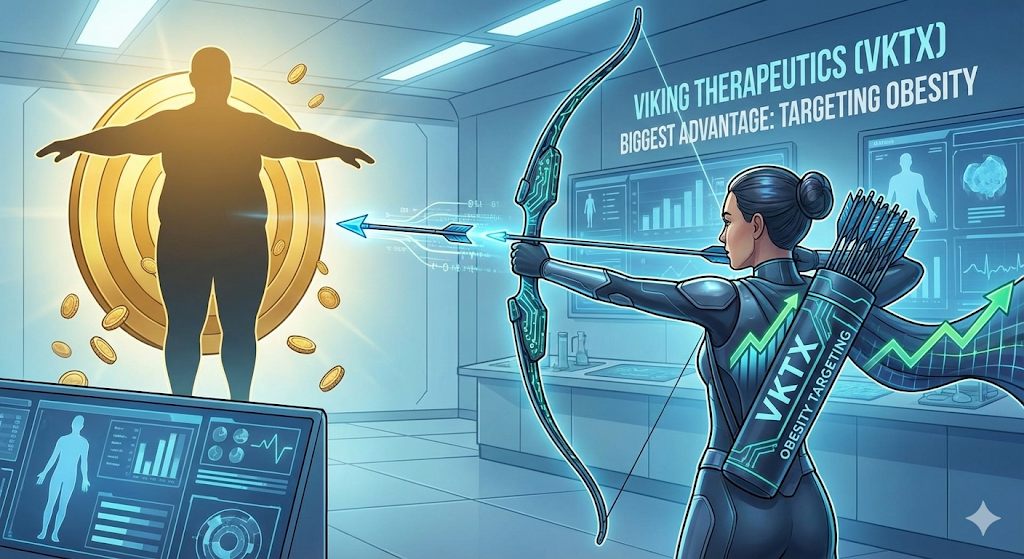
Few biotechnology companies have been shaped so deliberately around the idea that the largest healthcare challenges of the future will not be rare diseases or niche conditions, but widespread metabolic disorders affecting hundreds of millions of people worldwide. From its earliest days, this company was structured not as a single-asset developer chasing one clinical breakthrough, but as a platform designed to systematically pursue therapies for obesity, diabetes, and related endocrine diseases that are becoming defining health issues of the modern world.
Viking Therapeutics (NASDAQ:VKTX) was founded with a strategic focus on metabolic and endocrine disorders, choosing to build its research and development efforts around biological pathways that influence weight regulation, insulin sensitivity, lipid metabolism, and liver health. Rather than entering crowded therapeutic categories with limited growth, Viking Therapeutics, Inc. aligned itself with disease areas where unmet medical need, patient demand, and economic impact were all expanding simultaneously. This positioning allowed the company to build relevance in healthcare long before the obesity drug market became one of the most closely watched segments in the pharmaceutical industry.
The company’s early years were devoted to building scientific capabilities, securing intellectual property, and assembling a team with deep expertise in drug discovery, clinical development, and regulatory strategy. Viking Therapeutics, Inc. emphasized rational drug design and mechanism-based approaches, focusing on targets supported by strong biological and clinical rationale. This foundation shaped a pipeline philosophy centered on quality and strategic fit rather than sheer quantity of programs.
As the biotech landscape evolved, Viking Therapeutics, Inc. continued to refine its identity as a metabolic disease specialist rather than a generalist. The company developed programs targeting obesity, nonalcoholic fatty liver disease, insulin resistance, and hormonal pathways linked to energy balance. This thematic coherence allowed Viking Therapeutics, Inc. to accumulate specialized knowledge, relationships with key opinion leaders, and operational experience within a focused domain, increasing its credibility among partners, regulators, and investors.
The rise of GLP-1 based therapies in the broader market validated many of the assumptions that underpinned the company’s original strategy. As weight-loss drugs moved from fringe treatments into mainstream medicine, Viking Therapeutics, Inc. found itself operating in a space that suddenly attracted enormous capital, media attention, and strategic interest from global pharmaceutical companies. Because the company had been building in this area for years, it entered this new phase not as a latecomer, but as a participant with established assets and a clear development roadmap.
Over time, Viking Therapeutics, Inc. evolved from a research-driven organization into a clinical-stage company with multiple active programs, regulatory interactions, and late-stage trial preparations. This transition required building infrastructure for clinical operations, manufacturing, quality control, and regulatory compliance. The company’s background therefore reflects a shift from scientific exploration toward execution, scale, and commercialization readiness.
Financially, Viking Therapeutics, Inc. structured itself to maintain flexibility and longevity through long development cycles. Recognizing that metabolic drug development requires substantial investment before revenue is generated, the company emphasized capital planning, balance sheet strength, and staged progression through clinical milestones. This approach allowed Viking Therapeutics, Inc. to pursue ambitious programs without being forced into premature partnerships or distressed financing.
Geographically and strategically, Viking Therapeutics, Inc. positioned itself within the global pharmaceutical ecosystem, engaging with regulatory agencies, contract research organizations, manufacturing partners, and potential commercial collaborators. The company’s background is therefore intertwined not only with its own internal development, but with the broader evolution of the biotech industry toward specialization, platform science, and targeted innovation.
The company’s story is not defined by a single discovery or moment of success, but by a gradual alignment with some of the most important trends in modern medicine. Rising obesity rates, increasing recognition of metabolic disease as a chronic condition, and the healthcare system’s growing willingness to treat these issues pharmacologically all converged to make the company’s original focus increasingly relevant.
Today, Viking Therapeutics, Inc. stands as a company whose background reflects patience, thematic consistency, and strategic foresight. It was built not to respond to trends, but to anticipate them. Its evolution mirrors the shift in healthcare toward long-term management of chronic metabolic conditions, and its identity has been shaped by the belief that the greatest medical and commercial impact comes from addressing the diseases that affect the most people.
That history defines what the company is today and frames what it seeks to become: a biotechnology company rooted in metabolic science, built for scale, and positioned within one of the most consequential healthcare transformations of the twenty-first century.
Viking Therapeutics Is Quietly Building One of the Most Strategically Positioned Metabolic Drug Pipelines in Biotech
Viking Therapeutics Inc is often discussed in the market as a volatile biotech stock driven by clinical data, analyst revisions, and shifting investor sentiment, but that framing misses the deeper story of what the company is actually building. Beneath the surface of daily price moves, earnings estimates, and short-term underperformance lies a strategically constructed metabolic disease pipeline that is aligned with some of the largest and fastest growing pharmaceutical markets in the world.
Viking Therapeutics is not attempting to compete across dozens of therapeutic areas. Instead, it has focused its scientific resources on metabolic and endocrine disorders, including obesity, type 2 diabetes, and fatty liver disease, conditions that are expanding globally and placing enormous strain on healthcare systems. This focus gives Viking a structural tailwind that is independent of near-term stock performance or quarterly estimate revisions.
While the stock recently underperformed over a one-month period and carries a negative Zacks Rank, these signals primarily reflect short-term earnings expectations rather than the long-term value creation potential of a clinical-stage biotechnology company whose valuation is driven by future drug approvals, not current revenue.
CHECK THIS OUT: Here’s Why Apogee Therapeutics (APGE) Is Suddenly on the Radar of Biotech Investors and Coeptis Therapeutics (COEP) Is Not Profitable Yet — and That’s Exactly Why It’s Interesting.
Why Short-Term Weakness Does Not Invalidate the Long-Term Thesis
The recent pullback in Viking Therapeutics stock and its negative earnings projections are often misinterpreted as a sign of business deterioration. In reality, these numbers reflect the natural profile of a development-stage biotech company that is deliberately investing heavily in late-stage clinical trials.
The projected EPS decline and lack of revenue do not indicate that the business is failing. They indicate that the company is spending aggressively on Phase 3 obesity trials, regulatory preparation, manufacturing readiness, and clinical infrastructure. These expenses are not optional. They are the necessary cost of attempting to build a drug that can address a multibillion-dollar global market.
Biotech history repeatedly shows that the most successful drug developers look financially unattractive immediately before their pivotal clinical inflection points. That is precisely when spending is highest and revenue is still absent.
In this context, the market’s focus on quarterly EPS and near-term losses can create mispricing when investors lose sight of the fact that a single successful Phase 3 program can transform a company’s valuation far more than any short-term earnings fluctuation.
The Obesity Drug Market Is One of the Most Powerful Growth Drivers in Healthcare
The most important macro force behind the Viking Therapeutics bull case is the explosive growth of the obesity and metabolic disease drug market. Obesity is no longer viewed solely as a lifestyle issue. It is increasingly treated as a chronic disease with severe health consequences, driving enormous demand for effective pharmaceutical interventions.
The success of GLP-1 based therapies has validated the market and demonstrated that patients, doctors, insurers, and governments are willing to adopt and pay for weight loss drugs at scale. This has transformed obesity treatment into one of the largest commercial opportunities in pharmaceutical history.
Viking Therapeutics’ lead asset, VK2735, is a dual GLP-1 and GIP receptor agonist designed to address weight loss and metabolic regulation. This mechanism is directly aligned with the most commercially successful class of obesity drugs, while offering the potential for differentiation through dosing, tolerability, efficacy, or formulation.
The fact that Viking is developing both injectable and oral versions of VK2735 further expands its addressable market. Oral obesity drugs represent a potentially massive opportunity because they remove the psychological and logistical barriers associated with injections, enabling broader patient adoption.
Viking’s Pipeline Is Purpose-Built for Strategic Relevance
Beyond obesity, Viking Therapeutics has constructed a pipeline that targets multiple metabolic conditions, including fatty liver disease and insulin resistance. This diversification within a single biological domain is strategically important because it allows Viking to leverage shared scientific expertise while reducing dependence on a single asset.
This approach creates a platform effect rather than a one-drug company narrative. If VK2735 succeeds, it does not exist in isolation. It validates the company’s broader scientific strategy and increases the probability that other pipeline programs may also generate value.
Pharmaceutical acquirers and partners are often more interested in platforms than in single assets because platforms provide optionality, follow-on products, and long-term strategic positioning. Viking’s pipeline design reflects an understanding of this dynamic.
Institutional and Strategic Interest Follows Clinical Success, Not Earnings
One of the most misunderstood aspects of biotech investing is when institutional capital enters. Large pharmaceutical companies and institutional investors typically do not focus on early-stage earnings. They focus on clinical validation.
Once a drug demonstrates strong Phase 3 efficacy and safety, interest can change rapidly. Valuations reprice, partnerships emerge, and acquisition discussions become credible. This pattern has repeated across the biotech industry for decades.
Viking Therapeutics is approaching exactly that inflection zone. The market is currently focused on losses, downgrades, and relative underperformance. Strategic buyers and long-term investors are focused on clinical outcomes, mechanism validation, and market size.
Those two perspectives often diverge sharply before major revaluations occur.
Why the Current Narrative May Be Setting Up the Next Opportunity
The current market narrative around Viking Therapeutics is cautious. The stock has pulled back. Earnings estimates are negative. The Zacks Rank is unfavorable. Analysts are focused on near-term costs and losses.
But this is precisely the environment in which long-term biotech opportunities often form.
When expectations are low, valuations compress. When sentiment is negative, risk premiums rise. And when a company is quietly progressing through high-impact clinical programs in the background, that disconnect can create asymmetric opportunities for investors willing to look beyond quarterly noise.
Viking Therapeutics is not priced as if it owns a potential blockbuster obesity drug. It is priced as if it is a risky, unproven development company. That gap is where upside can emerge if clinical results confirm the promise of its science.
The Bullish Conclusion on Viking Therapeutics
Viking Therapeutics represents a convergence of three powerful forces. A massive and expanding obesity drug market, a pipeline directly aligned with the most commercially validated biological mechanisms in that market, and a valuation currently suppressed by short-term financial optics rather than long-term potential.
The company is spending heavily because it is attempting something difficult and valuable. It is losing money because it is investing in its future. It lacks revenue because it has not yet reached commercialization. None of these are flaws in the context of drug development. They are features of the process.
If VK2735 succeeds, and if Viking Therapeutics transitions from a development-stage biotech into a clinical success story, the stock will not be valued on Zacks ranks, quarterly EPS, or sector performance. It will be valued on revenue potential, market share, and strategic importance.
That is why, despite short-term underperformance and negative sentiment, Viking Therapeutics remains one of the most compelling asymmetric opportunities in the metabolic disease biotech space.
It is precisely when a company looks weakest in its financial statements that its scientific and strategic strength can matter most.
READ ALSO: Could UnitedHealth Group (UNH) Be the Safest Way to Invest in Healthcare Growth? and SELLAS Life Sciences Group (SLS) Just Took a Big Step Toward Changing How Cancer Is Treated.