What keeps breaking modern cancer treatment is not a lack of powerful drugs, but the simple fact that cancer learns faster than medicine expects. Therapies work, patients respond, optimism builds—then resistance sets in, outcomes stall, and the entire cycle starts over. This failure loop has defined oncology for decades and has quietly shaped where the most ambitious drug developers choose to operate. Instead of chasing incremental improvements in crowded indications, a new class of biotech companies emerged to attack the problem others treated as inevitable. That reality is the intellectual birthplace of ORIC Pharmaceuticals, Inc., long before it ever became a publicly traded NASDAQ biotech stock.
ORIC Pharmaceuticals Inc. (NASDAQ:ORIC) was built around a narrow but deeply consequential idea: cancer drug resistance is not an endpoint, it is a biological process that can be understood, targeted, and disrupted. Headquartered in South San Francisco, one of the world’s most competitive life science corridors, the company was founded as a clinical-stage biopharmaceutical firm focused exclusively on developing small molecule therapeutics designed to overcome resistance mechanisms in solid tumors. From the beginning, ORIC Pharmaceuticals differentiated itself from traditional oncology developers by treating resistance biology as the primary disease driver rather than a secondary complication.
The early identity of ORIC Pharmaceuticals was shaped by advances in molecular oncology that revealed how tumors rewire signaling pathways under therapeutic pressure. As precision medicine and genomics matured, it became increasingly clear that many treatment failures were predictable at the molecular level. ORIC Pharmaceuticals positioned itself to exploit that insight, designing its cancer drug pipeline around targets that emerge specifically after exposure to standard therapies. This strategy allowed the company to align its research with real-world clinical practice, where resistance—not lack of access—is often the defining challenge for patients with advanced cancer.
Unlike platform biotechs that scatter resources across unrelated programs, ORIC Pharmaceuticals constructed a focused development engine centered on solid tumor oncology. Its emphasis on orally available small molecule drugs reflects both scientific intent and commercial realism. Oral agents integrate more easily into combination regimens, improve patient adherence, and scale more efficiently in global markets. These attributes matter deeply in modern oncology drug development and help explain why resistance-focused therapies are increasingly attractive to regulators, physicians, and pharmaceutical partners alike.
As ORIC Pharmaceuticals matured, it established itself as part of a broader shift within the biotech industry toward smarter, biology-driven pipelines. The company’s background is tightly intertwined with the evolution of precision oncology, where biomarkers, adaptive trial designs, and mechanism-based drug selection have replaced one-size-fits-all approaches. This alignment has allowed ORIC Pharmaceuticals to remain relevant as treatment paradigms shift, reinforcing its positioning as a forward-looking oncology biotech rather than a speculative science project.
The leadership structure of ORIC Pharmaceuticals reflects this long-term orientation. The company has consistently emphasized scientific depth, translational rigor, and disciplined execution—qualities that resonate strongly with institutional investors evaluating clinical-stage pharmaceutical companies. Rather than marketing itself as a near-term commercial story, ORIC Pharmaceuticals has leaned into its identity as a research-driven organization built to survive the volatility inherent in oncology drug development. This mindset has helped shape its reputation within the biotech ecosystem and explains its unusually high level of institutional ownership for a company at its stage.
From a market perspective, ORIC Pharmaceuticals occupies a distinctive niche among NASDAQ biotech stocks. It is neither a single-asset gamble nor a sprawling platform company diluted by lack of focus. Its background reflects deliberate restraint, prioritizing programs that fit within a coherent scientific thesis centered on resistance mechanisms in cancer. This coherence strengthens the long-term narrative and makes the company easier to evaluate as data accumulates across its oncology pipeline.
As investor interest continues to gravitate toward clinical-stage biotech companies with differentiated science, ORIC Pharmaceuticals increasingly appears in discussions around oncology innovation, cancer drug resistance, and next-generation small molecule therapeutics. Its foundational decision to confront resistance directly has embedded the company in some of the most durable themes in modern cancer research. That background—not short-term price action or transient sentiment—is what ultimately defines ORIC Pharmaceuticals as a company built for relevance in an industry where relevance is brutally hard to earn.
ORIC Pharmaceuticals and the Strategic Focus on Cancer Resistance
ORIC Pharmaceuticals is not a generalist biotech chasing overcrowded indications. Instead, the company is tightly focused on one of the most persistent and costly problems in oncology: drug resistance. Many cancer therapies initially work, only to fail when tumors adapt and evolve. ORIC’s entire research and development strategy revolves around identifying the molecular mechanisms behind that resistance and designing small-molecule therapeutics that can restore or enhance treatment response.
This precision oncology approach is increasingly favored by both regulators and large pharmaceutical partners because it complements existing standards of care rather than competing directly with them. From a commercial perspective, drugs that overcome resistance are often used in combination settings, extending patient duration on therapy and significantly expanding addressable markets. This strategic positioning gives ORIC Pharmaceuticals a scientific and economic moat that is not always reflected in near-term stock price movements.
CHECK THIS OUT: Here’s Why Apogee Therapeutics (APGE) Is Suddenly on the Radar of Biotech Investors and Coeptis Therapeutics (COEP) Is Not Profitable Yet — and That’s Exactly Why It’s Interesting.
A Deep and Differentiated Oncology Pipeline Driving Long-Term Value
At the core of the ORIC Pharmaceuticals investment thesis is its oncology pipeline, which is designed to target multiple resistance pathways across solid tumors. The company’s programs are rooted in strong biological rationale, supported by translational data, and structured for combination use with existing therapies.
ORIC-101, a selective and orally available glucocorticoid receptor antagonist, exemplifies this strategy. It is being evaluated in Phase 1/2 trials for patients whose cancers have developed resistance to chemotherapy and hormonal agents. The glucocorticoid receptor has long been implicated in cancer cell survival under treatment stress, and inhibiting this pathway has the potential to resensitize tumors to therapy. Success here would not only validate ORIC’s scientific platform but also open doors to multiple expansion indications.
From an SEO standpoint, this positions ORIC Pharmaceuticals squarely within high-value search themes such as cancer drug pipeline, clinical stage biotech stocks, oncology therapeutics, and precision medicine investments.
Short Interest Surge as a Contrarian Bullish Signal
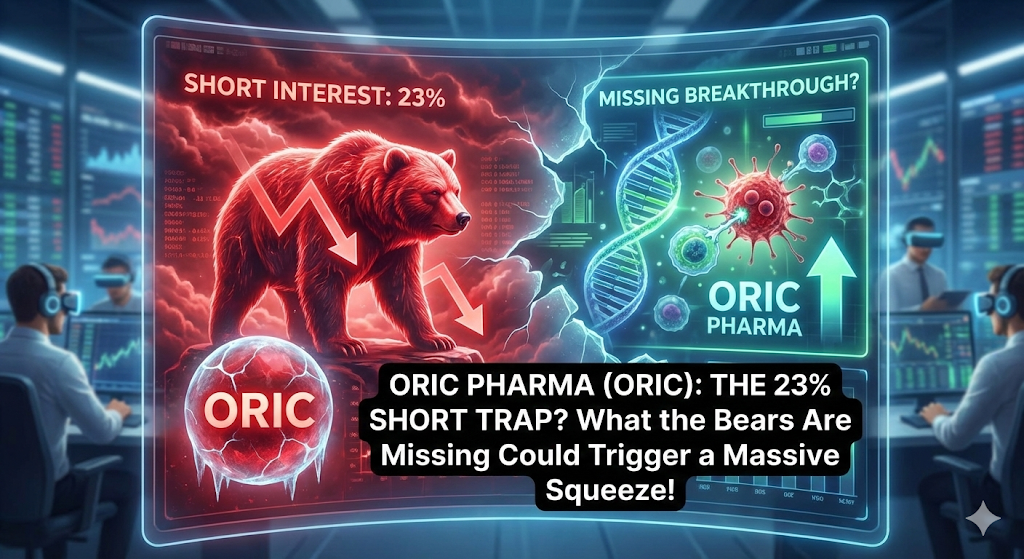
One of the most attention-grabbing developments surrounding ORIC stock is the sharp rise in short interest. As of the end of December, short interest jumped by nearly 20 percent to approximately 21.47 million shares, representing about 23.3 percent of the float, with a short-interest ratio of 14.2 days. On the surface, this appears bearish. However, in the context of biotech investing, elevated short interest often reflects skepticism about timelines rather than outright dismissal of scientific potential.
Historically, some of the most explosive biotech rallies have occurred when heavily shorted stocks delivered positive clinical updates or strategic announcements. With ORIC Pharmaceuticals approaching multiple clinical and operational milestones, the high short interest effectively becomes latent fuel. Any meaningful positive data, regulatory clarity, or partnership development could force rapid short covering, amplifying upside moves in ORIC stock far beyond what fundamentals alone would dictate.
For investors searching terms like ORIC stock short squeeze or heavily shorted biotech stocks, this dynamic is especially relevant.
Analyst Consensus Remains Constructively Bullish
Despite vocal skeptics in the market, analyst sentiment toward ORIC Pharmaceuticals remains notably constructive. The stock currently carries a consensus rating of Moderate Buy, with eleven Buy ratings, two Hold ratings, and only one Sell rating. The consensus price target of approximately $19.90 implies substantial upside from recent trading levels near $12, even after the stock’s recent 5.2 percent gain.
Recent coverage further reinforces this outlook. Piper Sandler initiated coverage with an overweight rating and a $22 price target, signaling confidence in the company’s long-term pipeline value. Citigroup raised its price target from $12 to $16 while maintaining a Buy rating, reflecting growing comfort with ORIC’s clinical trajectory and balance sheet strength. While a few firms have issued more cautious views, the overall analyst picture suggests that Wall Street continues to see ORIC Pharmaceuticals as undervalued relative to its potential.
This divergence between analyst targets and market price is a common feature of early-stage biotech stocks before major inflection points.
Insider Selling Does Not Undermine the Bullish Case
Insider selling often triggers alarm among retail investors, but context matters. Over the past three months, insiders at ORIC Pharmaceuticals sold approximately 54,814 shares, including a sale by CEO Jacob Chacko. Importantly, these transactions represented relatively small percentages of total insider holdings and were executed at prices well below current trading levels.
The CEO still retains a substantial equity stake worth several million dollars, maintaining strong alignment with shareholders. In biotech, insider sales are frequently tied to diversification, tax planning, or pre-arranged trading plans rather than deteriorating confidence. The absence of large-scale insider exits or resignations supports the view that insider activity at ORIC does not contradict the company’s long-term bullish narrative.
Strong Institutional Ownership Signals Confidence
Perhaps the most underappreciated strength of ORIC Pharmaceuticals is its institutional ownership profile. Approximately 95 percent of the company’s shares are held by hedge funds, asset managers, and other institutional investors. This level of institutional participation is unusually high for a clinical-stage biotech and reflects deep due diligence by sophisticated capital.
Recent activity shows both new positions and increased stakes from firms such as Hennion & Walsh Asset Management, SG Americas Securities, and Woodline Partners. Institutional investors are typically more tolerant of near-term volatility when they believe in long-term scientific and commercial potential. Their continued involvement provides stability and credibility to the ORIC Pharmaceuticals investment thesis.
For SEO purposes, this reinforces ORIC’s relevance in searches related to institutional biotech investments and NASDAQ biotech stocks with hedge fund ownership.
Financial Profile Supports Continued Execution
ORIC Pharmaceuticals reported a quarterly loss of $0.33 per share, beating consensus expectations and highlighting disciplined cost management. Analysts expect a full-year loss of approximately $2.17 per share, which is typical for a company at this stage of development. Importantly, ORIC maintains sufficient capital to fund its ongoing clinical programs, reducing near-term dilution risk and allowing management to focus on execution rather than survival.
With a market capitalization of roughly $1.18 billion, ORIC stock sits in a valuation range where positive clinical validation could meaningfully re-rate the company without requiring blockbuster assumptions.
Why ORIC Pharmaceuticals May Be Misunderstood by the Market
The disconnect between rising short interest and sustained analyst optimism suggests that ORIC Pharmaceuticals is currently misunderstood. The market appears fixated on near-term uncertainty while undervaluing the structural importance of resistance-targeting therapies in oncology. As precision medicine continues to evolve, companies that enable existing drugs to work better and longer may prove just as valuable as those introducing entirely new modalities.
ORIC’s scientific focus, institutional backing, and catalyst-driven roadmap create a setup where downside is increasingly defined while upside remains open-ended.
Long-Term Bullish Outlook for ORIC Stock
ORIC Pharmaceuticals, Inc. (NASDAQ: ORIC) represents a high-risk, high-reward biotech investment with multiple levers for value creation. Its focus on overcoming cancer drug resistance addresses a critical unmet need. Its pipeline is differentiated and strategically aligned with combination therapy trends. Analyst sentiment remains constructive, institutional ownership is exceptionally strong, and elevated short interest introduces the possibility of sharp upside moves if expectations shift.
For investors searching for undervalued oncology biotech stocks, ORIC stock stands out as a name where skepticism may already be priced in, while success is not. If ORIC delivers on even part of its scientific promise, today’s valuation may ultimately look conservative in hindsight.
READ ALSO: Could UnitedHealth Group (UNH) Be the Safest Way to Invest in Healthcare Growth? and SELLAS Life Sciences Group (SLS) Just Took a Big Step Toward Changing How Cancer Is Treated.