There are biotech companies that enter the rare-disease landscape with a single idea, and then there are those that gradually build a scientific identity grounded in a clear understanding of biology, unmet clinical need, and the realities of drug development. Immix Biopharma Inc. (NASDAQ:IMMX) has emerged from the latter category, evolving from a small oncology-focused startup into a biotechnology company positioned at the center of innovation in AL amyloidosis and plasma-cell driven diseases. What makes its background especially compelling is how its scientific direction has been shaped by the distinct behavior of amyloid-producing plasma cells and the challenge of eliminating them without causing overwhelming immune toxicity. Immix Biopharma has structured its entire therapeutic philosophy around this problem, creating a platform aimed at delivering immune-based therapies that are potent enough to clear diseased cells yet refined enough to avoid damaging the patient’s organs or triggering life-threatening cytokine responses.
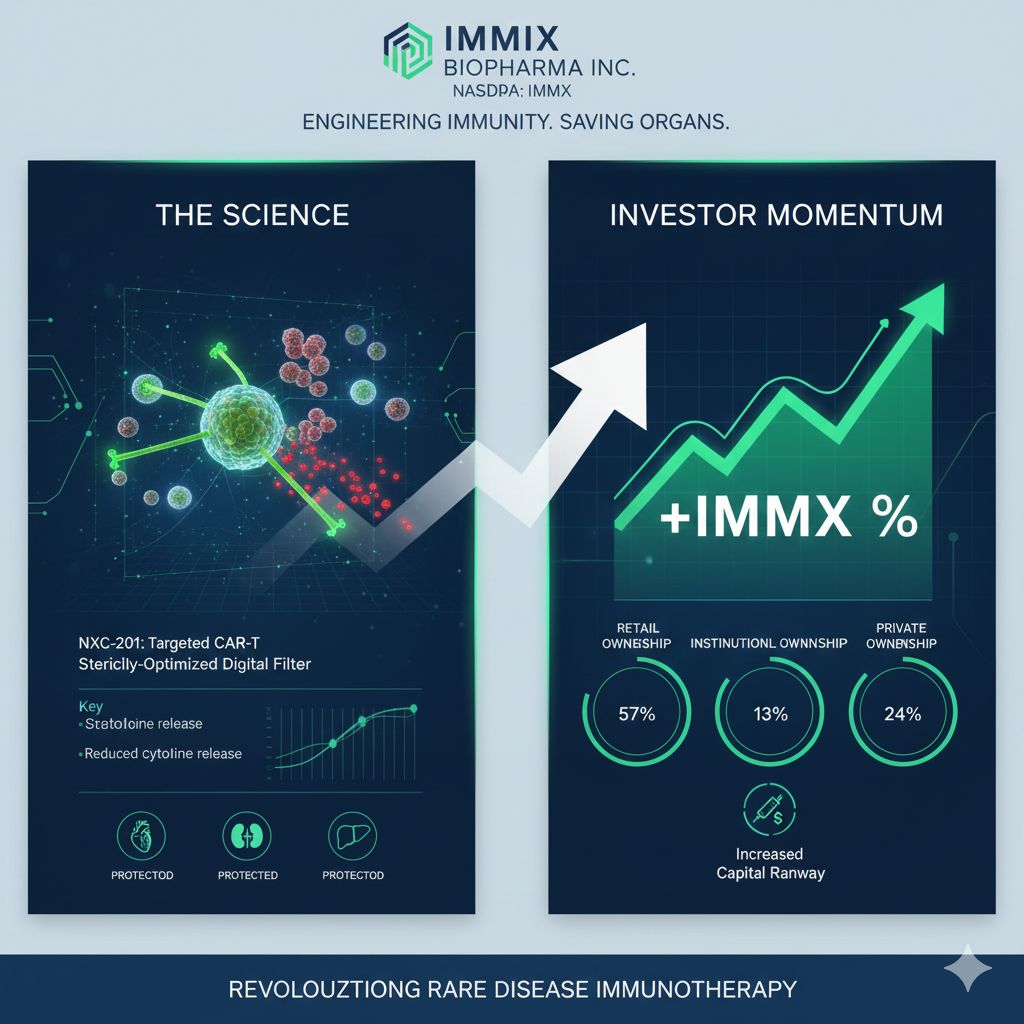
As the company expanded, it began developing a proprietary approach that blends cell-based immunotherapy with precision targeting. This culminated in NXC-201, a BCMA-directed CAR-T therapy designed specifically for relapsed and refractory AL amyloidosis, a condition marked by the production of misfolded light chains that accumulate in organs and progressively shut them down. While many CAR-T therapies rely on broad immune activation to destroy malignant cells, Immix opted for a design that behaves more like a selective filter. In simple terms, NXC-201 teaches the patient’s immune system to identify only the plasma cells producing toxic light chains by binding to BCMA, a marker uniquely expressed on these harmful cells. Once the engineered T cells locate BCMA, they activate and eliminate the source of the disease. What sets this therapy apart is the sterically-optimized nature of the CAR receptor, engineered to reduce unnecessary immune signaling and lower the risk of severe cytokine release syndrome, which is one of the biggest safety challenges associated with first-generation CAR-T platforms. By minimizing this overactivation, Immix is attempting to create a CAR-T therapy that not only works but is also more predictable and clinically manageable across treatment centers.
Immix Biopharma’s background is further defined by its commitment to studying organ-damaging diseases that are historically difficult to treat. AL amyloidosis is one of the rare disorders where even a slight improvement in plasma-cell suppression can translate into life-extending benefits, and Immix has pursued this field knowing that the patient population is underserved and that therapeutic innovation has lagged behind other hematologic cancers. The company’s research strategy gravitates toward diseases where immune modulation can produce meaningful change but where traditional chemotherapies or antibody treatments often lack the specificity needed to prevent relapse. This focus has shaped Immix into a company that thinks deeply about disease biology, drug delivery, and the balance between efficacy and tolerability.
As Immix continued to grow, its scientific credibility expanded through its ability to secure regulatory designations that reflect both unmet need and promising early data. Being awarded RMAT status by the FDA signals not only the seriousness of the disease the company is targeting but also the agency’s recognition that Immix’s therapy has the potential to offer substantial improvement over existing treatments. Orphan Drug Designation in the United States and Europe further anchors Immix’s background as a biotech company working at the intersection of rare disease and advanced immunotherapy. These regulatory advantages do more than streamline development; they reflect the strength of the biological rationale behind Immix’s approach and reinforce the company’s place within the global biotech ecosystem.
A major part of Immix Biopharma’s identity is the scientific philosophy underlying its SMARxT tissue-specific platform, which is engineered to deliver therapeutic agents in ways that align with the unique microenvironment of diseased tissues. Although still early in development, the platform reflects the company’s belief that successful oncology and amyloid therapies must match the biological behaviors of the diseases they aim to treat. Rather than force fit existing technologies into difficult indications, Immix designs its treatments around the pathological mechanisms driving those conditions. This emphasis on disease-specific engineering sets the company apart from many micro-cap biotech peers that rely on licensed or generalized therapeutic constructs.
As the pipeline evolved, Immix Biopharma built a research and operational structure capable of advancing not just CAR-T therapy but a broader exploration of immune-targeting strategies. Its background includes collaborations with clinical centers studying the progression of AL amyloidosis, the immunologic behavior of plasma cells, and the way protein misfolding affects organ decline. By anchoring its research in both cellular immunology and proteinopathy science, Immix has placed itself within two of the most dynamic fields in modern biotechnology. This dual focus strengthens its identity not merely as a CAR-T developer, but as a company integrating oncology, rare disease, and immune engineering into a cohesive development strategy.
Over time, Immix Biopharma’s progression from a concept-stage entity to a company conducting multi-center, registrational-design clinical trials reflects the depth of its scientific execution. The company’s evolution shows a steady movement toward becoming a specialized leader in diseases where toxic light chains, dysfunctional plasma cells, and immune dysregulation collide. This background supports a strong investment narrative rooted in the biological logic of its therapies, the rarity and severity of the diseases it targets, and its increasing ability to compete in the global biotech landscape through differentiated science, regulatory advantages, and a focused therapeutic mission.
Immix Biopharma Steps Into a Defining Moment as It Raises Capital to Accelerate NXC-201’s Development
Immix Biopharma has reached one of those pivotal moments where science, fundraising, and clinical momentum begin to align, creating the type of inflection point that attracts attention across the biotech landscape. Immix Biopharma Inc. (NASDAQ:IMMX), a company already recognized for its leadership in relapsed and refractory AL amyloidosis, has now strengthened its financial runway with a $100 million underwritten offering. For a clinical-stage biotech, this level of capital commitment—especially from major institutions and bookrunners like Morgan Stanley—is more than just a financing event. It is a sign that the company’s scientific thesis is resonating far beyond retail speculation. Analysts covering early-stage oncology and rare disease programs often point out that institutional participation at this scale usually reflects confidence in the underlying clinical data and the platform technology driving it.
READ ALSO: Tiziana (TLSA) Surges 143% in 2025 and Immuneering (IMRX) Reports 86% 9-Month Survival in Pancreatic Cancer.
Why Immix’s Lead Program NXC-201 Is Being Watched Closely by Analysts and Researchers
The heart of Immix Biopharma’s bullish story continues to be NXC-201, a next-generation BCMA-targeted CAR-T therapy engineered specifically for diseases marked by toxic light chain production, particularly relapsed and refractory AL amyloidosis. To understand why investors and clinicians are paying attention, it helps to break down the science in plain terms. AL amyloidosis occurs because plasma cells in the bone marrow begin producing defective light chains—tiny protein fragments that fold abnormally and accumulate in vital organs. These toxic deposits interfere with the function of the heart, kidneys, liver, and other systems, ultimately leading to organ failure.
Traditional treatments attempt to suppress plasma cell activity, but they often struggle to fully eliminate the problematic cells, especially in patients who have already failed multiple lines of therapy. This is where Immix’s technology stands out. NXC-201 utilizes CAR-T engineering to teach the patient’s own immune system to identify and destroy the abnormal plasma cells responsible for producing toxic light chains. The therapy incorporates what Immix describes as a “digital filter,” meaning the CAR-T construct is designed to avoid unnecessary immune activation. In early data, this appears to reduce the frequency of high-grade cytokine release syndrome, a dangerous immune overreaction associated with many first-generation CAR-T therapies.
In practical terms, this “digital filter” means NXC-201 aims to activate the immune system only when it detects the specific BCMA marker on malignant plasma cells, rather than indiscriminately triggering T-cell activity. This kind of engineered precision is where CAR-T therapy has been trying to evolve for years, and Immix’s approach is being seen as a possible turning point in making CAR-T safer and more scalable.
A Registrational Study That Signals Immix’s Transition Toward a Potential Approval Pathway
One of the strongest bullish signals for IMMX stock is the registrational design of its NEXICART-2 clinical trial in the United States. A registrational study means the trial is structured in a way that could support a future FDA approval if results continue to be positive. Immix already holds FDA Regenerative Medicine Advanced Therapy (RMAT) designation, which is one of the most valuable regulatory pathways available to a biotech company. RMAT is granted only to therapies addressing serious or life-threatening conditions with preliminary clinical evidence suggesting substantial improvement over existing treatments.
For analysts who follow the biotech sector, RMAT designation is often treated as an unofficial vote of confidence from regulators. It allows for more frequent FDA interaction, potential accelerated approval pathways, and the possibility of using smaller, more streamlined trial designs. Immix also holds Orphan Drug Designation in both the U.S. and Europe, which further reinforces the global regulatory confidence surrounding NXC-201 and strengthens the commercial incentives the company may be able to capture upon approval.
Why Immix’s $100 Million Offering Is More Than Just Dilution
While some retail investors instinctively react to offerings with concern, institutional investors tend to look at the larger context—especially when the offering is tied to a critical late-stage clinical program. Immix Biopharma made it clear that the proceeds from this $100 million raise, combined with existing cash, cash equivalents, and expected disbursements under its CIRM grant, should be sufficient to fund operations into mid-2027. This is vital because it gives the company a multi-year window to complete clinical milestones without scrambling for capital under pressure.
Financing stability is an underappreciated part of a bullish biotech thesis. When a company is financially secured through key phases of drug development, it reduces execution risk and allows management to focus entirely on clinical progress rather than fundraising. For Immix, this deepened capital pool also strengthens its position in partnering discussions—large institutions prefer to negotiate with companies that have leverage rather than those running on limited runway.
A Stronger Oncology and Rare Disease Narrative Emerging Around IMMX
Immix Biopharma’s broader value proposition is becoming clearer as more investors recognize the distinctiveness of the company’s approach. AL amyloidosis and multiple myeloma represent high-need spaces where traditional therapies often fail, and where long-term remission is difficult to achieve. CAR-T platforms have already proven their potential in hematologic cancers, but first-generation versions often come with high toxicity and complex administration challenges.
NXC-201 aims to open the door to a safer, more controlled CAR-T therapy that can be administered across more centers and possibly even expanded to earlier treatment lines. If Immix successfully positions NXC-201 as a next-generation BCMA-targeted therapy with improved tolerability, the addressable market becomes significantly larger than what early analysts estimated. This is where the bullish opportunity sharpens: a more scalable CAR-T with lower cytokine storm risk would not only be attractive for FDA approval, but also appealing to large pharmaceutical companies looking to expand their oncology portfolios through partnerships or acquisitions.
The Long-Term Bullish Thesis for Immix Biopharma Strengthens as Clinical and Financial Foundations Align
When assessing IMMX stock through a long-term lens, what stands out is the convergence of strong clinical science, regulatory tailwinds, and strengthened financial runway. The company is operating in a therapeutic space that combines unmet need with high commercial potential, and its lead therapy is supported by a clear biological rationale that differentiates it from the competition. Immix Biopharma’s rise is not based on hype but on the scientific engineering behind its CAR-T platform, the credibility signaled by RMAT designation, and the preparedness to fund clinical activity well into 2027.
Immix is moving into a critical period where data maturation, trial enrollment, and regulatory engagement will shape its trajectory. But unlike many early biotech firms, the company now has the capital structure to execute a multi-year strategy without interruption. This is where bullish investors see long-term potential: a rare-disease oncology company advancing a differentiated CAR-T platform, backed by institutional financing, and positioned in one of the most innovation-heavy fields in modern medicine.
READ ALSO: Tiziana (TLSA) Surges 143% in 2025 and Immuneering (IMRX) Reports 86% 9-Month Survival in Pancreatic Cancer.